blogs created to prevent or detect a crime http://www.opsi.gov.uk/acts/acts1997/ukpga_19970040_en_1

This blog is brougt to you consistent with subsection 3 of the Protection from Harassment Act - i.e. blogs created to prevent or detect a crime http://www.opsi.gov.uk/acts/acts1997/ukpga_19970040_en_1


Sunday, 10 April 2011

GlaxoSmithKline - Seroxat year 2000 suicidal behaviour SSRI core safety exercise

[text redacted S40 FOIA]


SmithKline Beecham Pharmaceuticals

11 August 2000

Dear[text redacted S40 FOIA]

RE: SSRIs and suicidal behaviour

As you are aware, the Committee on Safety of Medicines (CSM) has recently reviewed the issue of fluoxetine and other SSRIs and suicidal behaviour. The Committee concluded that the available study data did not support a causal association between SSRIs and suicidal behaviour. However there continued to be anecdotal reports of suicidal behaviour associated with SSRIs. The Committee noted that it was general clinical experience that patients taking antidepressants may develop an increase in suicidal behaviour in the first few weeks of treatment.

The CSM considered that patient information leaflets for SSRIs should be updated to ensure consistency with the SPC statement introduced in the recent SSRI core safety exercise. They felt that the following wording was appropriate:


'Occasionally, thoughts of suicide or self harm may occur or may increase in the first few weeks of treatment with paroxetine, until the antidepressant effect becomes apparent. Tell your doctor immediately if you have any distressing thoughts or experiences.'

Your variation to update the SPC is currently under assessment. I would be grateful if you would submit a revised PIL including the above statement. I have assessed the PIL as it stands and no other amendments are required.

Please do not hesitate to contact me if you require any further information.

Yours sincerely
[text redacted S38 FOIA]
Senior Scientific Assessor
Pharmacovigilance Group
Copy: [text redacted S38 FOIA]

Eli Lilly asked to revise and strengthen SSRIs and suicidal behaviour warning - fluoxetine / prozac year 2000

[text redacted S40 FOIA]

Eli Lilly and Company Limited

By Fax: 01256 315435

16 August 2000

Dear [text redacted S40 FOIA]

RE: SSRIs and suicidal behaviour

Thank you for your e-mail with the proposed wording relating to suicide for the Prozac PIL.


The wording that you propose implies that thoughts of suicide that are already present may not get better immediately. This is not entirely consistent with the wording recently added to the Prozac SPC which states that the risk of suicide may increase in early stages of recovery.


'Suicide: As improvement may not occur during the first few weeks of treatment, in common with all antidepressants, patients should be closely monitored during this period. The possibility of a suicide attempt is inherent in depression and may persist until significant remission occurs. It is general clinical experience with all therapies for depression that the risk of suicide may increase in the early stages of recovery.'

I therefore request that you incorporate the following wording which is proposed by the CSM into the statement that Lilly have developed:

Occasionally, thoughts of suicide or self harm may occur or may increase in the first few weeks of treatment with fluoxetine, until the antidepressant effect becomes apparent. Tell your doctor immediately if you have any distressing thoughts or experiences.'


I will be away from the office from 18th to 1st August inclusive. In me absence, please contact [text redacted S38 FOIA]if you have any questions (telephone number [text redacted S38 FOIA]


Yours sincerely
[text redacted S38 FOIA]
Senior Scientific Assessor
Pharmacovigilance Group
Copy: [text redacted S38 FOIA]

Lundbeck Limited - cipramil citalopram - SSRIs and suicidal behaviour warning request August 2000

text redacted S40 FOIA]

Lundbeck Limited

11 August 2000


Dear[text redacted S40 FOIA]


RE: SSRIs and suicidal behaviour

As you are aware, the Committee on Safety of Medicines (CSM) has recently reviewed the issue of fluoxetine and other SSRIs and suicidal behaviour. The Committee concluded that the available study data did not support a causal association between SSRIs and suicidal behaviour. However there continued to be anecdotal reports of suicidal behaviour associated with SSRIs. The Committee noted that it was general clinical experience that patients taking antidepressants may develop an increase in suicidal behaviour in the first few weeks of treatment.

The CSM considered that patient information leaflets for SSRIs should be updated to ensure consistency with the SPC statement introduced in the recent SSRI core safety exercise. They felt that the following wording was appropriate:

'Occasionally, thoughts of suicide or self harm may occur or may increase in the first few weeks of treatment with citalopram, until the antidepressant effect becomes apparent. Tell your doctor immediately if you have any distressing thoughts or experiences.'

Your variation to update the SPC is currently under assessment. I would be grateful if you would submit a revised PIL including the above statement. I have assessed the PIL as it stands and no other amendments are required.

Please do not hesitate to contact me if you require any further information.

Yours sincerely
[text redacted S38 FOIA]
Senior Scientific Assessor
Pharmacovigilance Group
Copy: [text redacted S38 FOIA]

Solvay Healthcare Limited - fluvoxamine / luvox / faverin - SSRIs and suicidal behaviour warning request August 2000

[text redacted S40 FOIA]


Solvay Healthcare Limited


14 August 2000      


Dear [text redacted S40 FOIA]


RE: SSRIs and suicidal behaviour


I am writing further to our telephone discussion today. As you are aware, the Committee on Safety of Medicines (CSM) has recently reviewed the issue of fluoxetine and other SSRIs and suicidal behaviour. The Committee concluded that the available study data did not support a causal association between SSRIs and suicidal behaviour. However there continued to be anecdotal reports of suicidal behaviour associated with SSRIs. The Committee noted that it was general clinical experience that patients taking antidepressants may develop an increase in suicidal behaviour in the first few weeks of treatment.


The CSM considered that patient information leaflets for SSRIs should be updated to ensure consistency with the SPC statement introduced in the recent SSRI core safety exercise. They felt that the following wording was appropriate:


'Occasionally, thoughts of suicide or self harm may occur or may increase in the first few weeks of treatment with fluvoxamine, until the antidepressant effect becomes apparent. Tell your doctor immediately if you have any distressing thoughts or experiences.'


Your variation to update the Faverin SPC is currently under assessment. I would be grateful if you would submit a revised PIL including the above statement.


Please do not hesitate to contact me if you have any queries regarding this.


Yours sincerely


[text redacted S38 FOIA]


Senior Scientific Assessor


Pharmacovigilance Group


Copy: [text redacted S38 FOIA]


Pfizer - Lustral (sertraline hcl) August 2000 request for suicidal behaviour warning - mca / mhra

text redacted S40 FOIA]


Manager, Regulatory Affairs

Pfizer Limited

14 August 2000

Dear[text redacted S40 FOIA]

RE: SSRIs and suicidal behaviour

As you are aware, the Committee on Safety of Medicines (CSM) has recently reviewed the issue of fluoxetine and other SSRIs and suicidal behaviour. The Committee concluded that the available study data did not support a causal association between SSRIs and suicidal behaviour. However there continued to be anecdotal reports of suicidal behaviour associated with SSRIs. The Committee noted that it was general clinical experience that patients taking antidepressants may develop an increase in suicidal behaviour in the first few weeks of treatment.

The CSM considered that patient information leaflets for SSRIs should be updated to ensure consistency with the SPC statement introduced in the recent SSRI core safety exercise. They felt that the following wording was appropriate:

'Occasionally, thoughts of suicide or self harm may occur or may increase in the first few weeks of treatment with sertraline, until the antidepressant effect becomes apparent. Tell your doctor immediately if you have any distressing thoughts or experiences.'

Your variation to update the SPC is about to be submitted. I would be grateful if you would revise PIL to include the above statement.

Please do not hesitate to contact me if you require any further information.

Yours sincerely

[text redacted S38 FOIA]
Senior Scientific Assessor
Pharmacovigilance Group
Copy: [text redacted S38 FOIA]

FOI 09 086 which makers of antidepressants received a request to include year 2000 ssri Suicide warning - mca/mhra

By email only to jeremybryce1953@...


source - http://health.groups.yahoo.com/group/criticalpsychiatry2/message/9862

FOI 09 086


9 April 2009


Dear Mr Bryce


Thank you for your Freedom of Information Act (FOIA) request of 12 March. As this is for Vigilance and Risk Management of Medicines Division it has been passed to me for reply.


You have asked which makers of antidepressants received a request to include the following statement in product information:


"Occasionally thoughts of suicide or self harm may occur or may increase in the first few weeks of treatment with (insert name of drug) , until the antidepressant effect becomes apparent. Tell your doctor immediately if you have any distressing thoughts or experiences."


The following companies were contacted:

Pfizer Limited

Solvay Healthcare Limited

SmithKline Beecham Pharmaceuticals

Lundbeck Limited

Eli Lilly and Company Limited.


Please find the text of letters sent to the companies attached. I have removed names of MHRA staff under S38 FOIA (health and safety) and information that could identify a third party under Section 40 (personal information).


All the companies updated their product information to include this wording by submitting a variation.


If you have a query about this letter, please contact me. If you are unhappy with our decision to withhold certain information, you may ask for it to be reviewed. That review will be undertaken by a senior member of the Agency who has not previously been involved in your request. If you wish to pursue that option please write to the Communications Directorate, 10th Floor, Medicines and Healthcare products Regulatory Agency, at the above address quoting the above reference. After that, if you remain dissatisfied, you may ask the Information Commissioner at


The Information Commissioner's Office
Wycliffe House
Water Lane
Wilmslow
Cheshire
SK9 5AF

to make a decision on whether or not we have interpreted the FOIA correctly in withholding information from you.


Yours sincerely
Stephen Fawbert

Saturday, 9 April 2011

years before fiddaman first took seroxat doctors knew about discontinuation problems

years before fiddaman first took seroxat doctors knew about discontinuation problems


But Seroxat has had special problems almost from the day it was licensed some 10 years ago. In 1993, the committee on safety of medicines - which advises the MCA - warned doctors that in light of "symptoms occurring on withdrawal ... including dizziness, sweating, nausea, insomnia, tremor and confusion ... [it] should not normally be discontinued abruptly."


http://www.guardian.co.uk/comment/story/0,3604,492305,00.html

proposed class wide suicide warning for all SSRI year 2000 - not just Seroxat

extract from article - 17 May 2001


"the medicines control agency, decided almost a year ago to ask drug companies including GlaxoSmithKline the world's biggest, to warn patients of a possible risk of suicide associated with Prozac-style drugs. Glaxo's Seroxat is one of the most prescribed. "


"Occasionally thoughts of suicide or self harm may occur or may increase in the first few weeks of treatment with Seroxat, until the antidepressant effect becomes apparent. Tell your doctor immediately if you have any distressing thoughts or experiences."


The missing warning on a drug for desperate people


http://www.guardian.co.uk/comment/story/0,3604,492305,00.html


Users of an antidepressant are not yet being alerted to a possible suicide risk


Ed Harriman

Thursday 17 May 2001

The Guardian


It may seem hard to believe that a big drug company would drag its feet over an official request to provide depressed people with warnings that might save their lives. But that is what appears to be happening.


The government's watchdog, the medicines control agency, decided almost a year ago to ask drug companies including GlaxoSmithKline the world's biggest, to warn patients of a possible risk of suicide associated with Prozac-style drugs. Glaxo's Seroxat is one of the most prescribed.


In August, the agency wrote asking the firm to include the following straightforward words on the patient information leaflets stuffed into drug packets:


"Occasionally thoughts of suicide or self harm may occur or may increase in the first few weeks of treatment with Seroxat, until the antidepressant effect becomes apparent. Tell your doctor immediately if you have any distressing thoughts or experiences."


Dr Keith Jones, director of the agency, said at the time: "The committee on the safety of medicines ... considered it was important that patients and the families of patients were made aware of a possible risk of an increase in suicidal behaviour." He added: "We are taking this issue very seriously."


However, patients prescribed GlaxoSmithKline's wonder drug will today look in vain for this warning. It seems the firm does not like the wording.


A director, Ian Hudson, was asked about this last December during US legal proceedings by lawyer Andy Vickery: (The drug is called Paxil in the US):


Vickery: "Incidentally, is SmithKline going to implement the new suicide warning that the medicines control agency in the UK recommended back in August of this year?"


Hudson: "Could you refer to ... tell me exactly what the warning is?"


Vickery: "The warning concerning suicide, suicide and Paxil. Have you seen it?"


Hudson: "Well SmithKline Beecham and the MCA have been in discussion in relation to ... including some wording within the UK data sheet. Exactly what the final wording will be, I don't know, I haven't seen it. I would have to consult my colleagues on that..."


Vickery: "But is SmithKline Beecham going to implement a wording change with respect to the issue of suicide on the Paxil label some time in the near future?"


Hudson: "We've certainly been in discussions with the MCA about that. I'm not sure whether that's finally resolved and when that's going to happen..."


(Shortly afterwards, Hudson left Glaxo and joined the medicines control agency in a senior position, although it is not suggested he personally handled this issue thereafter.)


Glaxo's public relations staff say their own, different wording was proposed to the agency in March and is now lying on the table. But they say it is "confidential".


So, to date, depressed patients continue to go without any warning at all.


Behind this bewildering and somewhat unsavoury delay, lie bigger issues. There is looming litigation, and large sums may be at stake for manufacturers of what has been hailed for years as a miracle drug.


Seroxat is an SSRI - a selective serotonin reuptake inhibitor - an antidepressant that works by changing the chemistry in the brain. SSRIs are being marketed for an ever-widening range of complaints, including premenstrual tension.


The chemical is GlaxoSmithKline's biggest selling drug, raising some £1.5bn last year, nearly £100m in the UK. Only Eli Lilly's Prozac, of all the SSRI's, outsells it. Many depression victims say it has helped them greatly.


But Seroxat has had special problems almost from the day it was licensed some 10 years ago. In 1993, the committee on safety of medicines - which advises the MCA - warned doctors that in light of "symptoms occurring on withdrawal ... including dizziness, sweating, nausea, insomnia, tremor and confusion ... [it] should not normally be discontinued abruptly."


Since then more adverse re action reports have been filed about Seroxat for problems associated with withdrawal symptoms than for all the other antidepressants, including Prozac, combined.


Suicide risk is another matter where GlaxoSmithKline faces challenges. This Monday, the firm goes on trial in Wyoming sued by the survivors after Donald Schell ran amok, shot family members and turned the gun on himself, two days after he was prescribed the drug in 1998. The family and Vickery, their no-nonsense Texas lawyer, hope to convince a jury that the drug triggered Mr Schell to go berserk. The firm deny this.


"What I intend to prove is that SmithKline knew about this potential risk for violence and suicide," says Vickery. It was he who recorded the deposition from Dr Hudson, then SmithKline's vice-president for clinical safety based in Harlow, Essex.


One of the big selling points of all SSRIs has been that they are less risky than older antidepressants, so-called tricyclic drugs. Promotion literature states boldly that Seroxat is "safe-in-overdose": if a patient swallows a bottle that in itself is unlikely to kill them.


But this is no longer the whole story, due to a crucial new study. Before Christmas an article appeared in the British Journal of Psychiatry by Dr Stuart Donovan and colleagues. It's their report of 2,776 patients taking SSRIs who turned up at Derbyshire Royal Infirmary over two years. They found that if you look for a statistically significant relationship between taking SSRIs and suicide by overdosing on them, you won't find much.


But they did find a relationship between taking SSRIs and all forms of deliberate self-harm - including overdose, attempted overdose, hanging, gassing, laceration, deliberate road traffic accidents, head banging, swallowing non-medicines - much higher for SSRIs than for the older tricyclics. (This applies whether the cause is SSRIs themselves or merely the delay in their effect.)


The relationship is so strong, Dr Donovan says, that he firmly believes promotional material for SSRIs including Seroxat should be changed immediately so doctors no longer prescribe them to potentially suicidal patients thinking, mistakenly, that by doing so they are protecting their lives.


Dr Donovan sent the manuscript to SmithKline Beecham (who partly financed the study with Eli Lilly) before it was published asking for comments. They never replied.


This history of controversy is hardly calculated to make depressed patients on Seroxat feel more comfortable. If they're worried - and indeed, as the warning with their pills would have told them had it been included by now - they should see their doctors for advice.


• Ed Harriman is an investigative film-maker


EdHarriman@compuserve.com


Seroxat litigation: Sandra Bailey & Ors v GlaxoSmithKline UK

Seroxat litigation: Sandra Bailey & Ors v GlaxoSmithKline UK


A group action against GlaxoSmithKline UK where claimants are alleged to have suffered withdrawal effects when reducing, discontinuing or attempting to discontinue use of the anti-depressant Seroxat, and that such effects amount to personal injury.


Claimant lawyers:


Hugh James partner partner Mark Harvey instructed 7 Bedford Row’s Simeon Maskrey QC and Julian Matthews.

Defendant lawyers:


Addleshaw Goddard partner John Kelleher instructed Henderson Chambers’ Charles Gibson QC, Prashant Popat QC and Andrew Kinnier to represent GlaxoSmithKline UK.

Hearing date: February for 12-14 weeks.


Judge and court: Mr Justice MacKay; Queen’s Bench Division.


FIDDAMAN - prepared to retire his blog in exchange for six figures from GlaxoSmithKline?

Did Bob tell you that he is prepared to retire his blog in exchange for six figures from GlaxoSmithKline?


but he settled for a cheap
date with Scientology


Friday, 8 April 2011

Scientology, Doyle Mills, Catholic Church & the Pave the Way Foundation

http://forums.whyweprotest.net/threads/doyle-mills-osabot.78333/


Doyle is on Facebook:

http://www.facebook.com/doylemillsusa#!/doylemillsusa?sk=info

(Denise Miscavige Gentile is a friend). He is also on the Board of Directors for a controversial foundation with ties to the Roman Catholic Church (what's new?).. http://www.blogger.com/goog_975986761


Other Board members Karen Hadley, David Hauser (lives in LA) and Dennis Dubin (deceased) are Scilons.

Photo of Doyle and 'Pave The Way' Foundation head Gary Krupp with Pope John Paul in Rome, 2005, shortly before the Pope's death. There's other photos of Doyle & friends outside the Vatican on his Myspace page.


http://www.myspace.com/justplanedoyle/photos

Scientology's LEAF Project Letters to the Editor Attack Force

Scientology's LEAF Project Letters to the Editor


http://forums.whyweprotest.net/threads/scientologys-leaf-project-letters-to-the-editor.2440/
 
Every thing in Scientology is choreographed... a SHOW, an apparency, designed to leave the uniformed public confused and to provide an
apparency of agreement that there is 'public' belief that a certain desired fallacy that benefits the coffers of $cientology is true


Teen Screen is legislation to interview school kids to prevent

SUICIDES...that is opposed by the scam of scientology, because it is based upon psychology and psychiatry...


I never had any doubt that all the letters to editors and the anti-
psych spam was coordinated, but you'll LOVE THIS:


"LEAF" = Letters to the Editor Attack Force


It was / is an actual group set up to do this...


Run by Doyle Mills, CW scientologist and OSA volunteer. He also works
at Digital Light Wave


Note that in some of the letters he says: "report compliance by

email"

So his "LEAF" operatives are commanded to report completion of
assignments

back to him!

http://forums.whyweprotest.net/threads/scientologys-leaf-project-letters-to-the-editor.2440/


Doyle Mills - Scientology Service Completions


http://www.truthaboutscientology.com/stats/by-name/d/doyle-mills.html

Scientology's LEAF Project - Letters To The Editor Attack Force - Exposed
http://groups.google.com/group/alt.religion.scientology/browse_thread/thread/944ee8cf50e0ee56/a661ab2134a23a9a?pli=1

SEROXAT PAXIL child killer David Carmichael drops civil action against GSK - a narcissist who would turn Paxil, into a meal ticket for life

Carmichael, who’s not pursuing civil action against Paxil’s maker, says politics is the best avenue to get his point across about what he feels is the over-diagnosis of mental illness and the over-prescribing of prescription drugs.


“You cannot lobby against multinational companies. Their tentacles are too deep. They have too much money,” said Carmichael.


http://www.cottagecountrynow.ca/news/article/978022--independent-candidate-enters-federal-race

Independent candidate enters federal race


Independent candidate enters federal race. ONE ISSUE:


Independent candidate David Carmichael is running on a platform centred on health care and big pharma. MUSKOKA - “Health care may be a provincial jurisdiction, but protecting the health of Canadians and promoting health is a federal responsibility,” says David Carmichael.

The Huntsville resident said this is the driving force behind his decision to run in the federal election as an independent candidate.

Carmichael lists his occupation as a sport consultant and former director of national projects at ParticipAction when it closed its doors in 2001.

He has a tragic past that has motivated him to become involved in politics.

In July, 2004, Carmichael drugged his son with sleep medication and suffocated the then 11-year-old boy in what he describes as an antidepressant-induced psychosis.

He was later found to be not-criminally-responsible because of a mental disorder and received an absolute discharge, which means he has no criminal record.

Carmichael believes he killed his son Ian because of side effects he wasn’t aware of as a result of an antidepressant.

He had altered his prescribed doses of Paxil, which he had been prescribed for depression, without consulting his doctor. That, he believes, sent him into psychosis.

At the trial, psychiatrists testified Carmichael had severe depression and instances of psychosis.

He said his depression — which was diagnosed in 2003 at age 45 — first surfaced when he wasn’t exercising regularly.

The psychosis came later. After forgetting to take his antidepressant for a few days, feeling better, he weaned himself off the drugs in early 2004.

When his symptoms returned, he restarted his medication, upping the dose.

Playing with the dosage, he says, triggered the psychotic episode when he killed Ian, believing his son was in living hell, permanently brain-damaged and going to hurt other children.

And now he’s running for federal office as an independent candidate. His agenda includes increased funding for disease, disorder and illness prevention. He hopes to prevent other similar tragedies from happening.

“I feel I have a responsibility both to my son and daughter … to try and make sure that you break the silence and stigma associated with mental illness and even health care and start to ask more questions of our doctors,” said Carmichael, who has a master’s degree in physical and health education from York University.

Before his depression, he had a long-running career in high profile, healthy living centred jobs such as director of ParticipAction.

“If I had asked more questions, this whole tragedy may have been prevented,” he said.

Carmichael, who’s not pursuing civil action against Paxil’s maker, says politics is the best avenue to get his point across about what he feels is the over-diagnosis of mental illness and the over-prescribing of prescription drugs.

“You cannot lobby against multinational companies. Their tentacles are too deep. They have too much money,” said Carmichael.

“I never aspired to be a politician, but I do aspire for public education.”

Preventing disease, whether physical or mental, says Carmichael, needs to start at the federal level.

“I know I can’t compete with the big blue machine. It’s David versus Goliath,” said Carmichael. “However, it doesn’t mean the issues can’t be raised.”

He admits he is a one-issue candidate.

“Health Canada has not done enough to protect the health of Canadians against the adverse and potentially lethal side effects of prescription drugs while the cost of prescription and over-the-counter drugs have increased from $4 billion in 1989 to $31 billion in 2010.

“In fact, the pharmaceutical industry seems to be self-regulated by Canada’s Research-Based Pharmaceutical Companies (Rx&D), the national association that represents big pharmaceutical companies,” he wrote in a press release.

Thursday, 7 April 2011

Bob Fiddaman and the Scientology/CCHR Connection

Bob Fiddaman and the Scientology/CCHR Connection


"Over the last few weeks we've really attempted to highlight the true nature of Bob Fiddaman and his sudden love affair with CCHR. Bob's motives as a self proclaimed "Activist" is laughable. "Human Rights Activist?" Ludicrous!


We've had a few surprises along the way. But it was no surprise that Bob Fiddaman persists, provokes, antagonizes, distorts, fabricates, and is intrusive. Rather than addressing allegations Bob has chosen to post articles about cyber stalking to threaten and intimidate. We're not intimidated.

What does Bob Fiddaman tell his fellow Advocates? What has he told Toran Henry's mother, Sara Carlin's parents, and the others? How much money has each family "donated" to the Bob Fiddaman Fund? I think his followers will be surprised at the answers to those questions. "

read more here - http://ssocialactivism.blogspot.com/2011/04/bob-fiddaman-and-scientologycchr.html?

Why would Fiddaman "review" a completed blog designed and designated as a visual aide in raising awareness of SSRI, SNRI prescriptions escalating at an adjusted median 1,74 million per annum in the UK

Why would Fiddaman "review" a completed blog designed and designated as a visual aide in raising awareness of SSRI, SNRI prescriptions escalating at an adjusted median 1,74 million per annum in the UK


and the unscrupulous activities of the Government, MHRA and NICE in using UK Government investigation reports to facilitate net drug cost reductions from £355 million to £195 million in four years,
 

whilst letting a situation akin to the Benzodiazepine debacle continue...

who would turn two mentions of the words "adverse drug reactions (ADRs), side effects and withdrawal problems"


from this


"Thursday, 7 May 2009


"The increase in the marginal trend reversal of Paroxetine"

"Total Prescriptions in 2002 correlates with: -

3 UK – The Observer February 3, 2002 article “Hard habit to break”, Mark Harvey, of Hugh James Solicitors, Cardiff; instigates further publicity of the adverse drug reactions (ADRs), side effects and withdrawal problems, connected with the Seroxat --- but common to all drugs in the SSRI / SNRI class."

"Significantly, the parliamentary interest and media coverage given to Seroxat and the continuing down trend in Paroxetine prescriptions has had NO impact on the overall marginal trend increases in prescription numbers for the drug class, although ALL are affected by the same ADRs, side effects and withdrawal problems."

http://tuesday1st.blogspot.com/2009/05/doh-1998-2008-england-ssri-snri_2963.html


into this


"New Blog from 'Anti-Seroxat Litigation Campaigner'

It seems the purpose of the following blog I am about to review is to show how Seroxat isn't the worst SSRi to taper from and, it seems, to show, how other SSRi's have a higher rate of withdrawal problems.

The author, 'Tuesday1st' [That's the name she chooses to go by] highlights that there are many dangers with a whole class of SSRi's, I think she assumes that I don't know this as she, has in the past, accused me of focusing on a single issue [that being Seroxat] - she may once again wish to read the minutes from the meeting I had with the MHRA and may also like to learn that I have another meeting pencilled in to discuss patient involvement with the MHRA."


apart from a fantasist and liar like Bob Fiddaman...

who has made great issue of his struggles with the MHRA and UK Government officials, a person who is definitely not a "patient advocate" speaking out for all those affected by all SSRI, SNRIs and

who has since spent almost two years stalking, harassing and writing malicious communications about the blogs author because the UK Government statistics, not the author, undermined the UK Seroxat Litigation, in which he was a litigant, and his own financial and ego driven agenda.

Whether he is a self serving loose cannon or a useful tool of the Scientology linked UK Seroxat Litigation Lawyer, the CCHR who have given him a Human Rights Award for as yet unspecified activities or Scientology itself, has yet to be definitively confirmed.

Please note: Tuesday1st had read the minutes of Bob Fiddamans meeting with the MHRA --a fact he was well aware of-- and had personally thanked Bob Fiddaman for widening the issue on the Mental Magazine group September 11th 2008 Re: Meeting with MHRA which is in the thread started by self-promoting Bob Fiddaman, found here
http://health.groups.yahoo.com/group/mentalmagazine/message/12405

first there was WIKILEAKS now it appears there are FIDDYLEAKS


"Bob is now fully aware that we are not kidding around about the leaked data from his personal computer. And, I for one, can attest that since this time Bob Fiddaman has been googling "anonymous proxy server leak." He now knows that this is a common occurrence, as we said, and a real problem he now faces.


source - http://ssocialactivism.blogspot.com/


Rather than correcting the problem of his daily patterns and routines he posted another libelous statement about the man he routinely targets. The same man whose children Bob Fiddaman follows on twitter, Bebo, Facebook, and the same children he made unsolicited contact to.

Sometime between the hours of 4am and 2pm Bob Fiddaman changed his IP address. This, of course, was after he read yesterday's post assuring him that his days of credability are number. "


more here - http://ssocialactivism.blogspot.com/


After reviewing another hours worth of Bob Fiddaman emails, searches, and anything else he typed on his computer - I maintain - For a jelous, controlling, insecure, emotional vampire type, Bob was no faithful hound. Isn't that always the way? He was a trickster.

Champix - no trace found at postmortem - so how does FIDDAMAN conclude it's implicated in murder/suicide

Two empty packs of the prescribed drug Champix were found in the kitchen of the home when police were examining the gruesome scene.


But Southampton Coroner's Court heard how there was no trace of the medicine in the 33-year-old's body when it was later examined by a pathologist


http://www.bournemouthecho.co.uk/news/8957759.Case_family_inquest__Man_kills_wife_and_two_daughters/

A DAD who killed his wife and two children may have been using prescribed anti-smoking medicine with possible side effects of "anger" and "depression", an inquest heard.


Andrew Case had been trying to quit smoking for some time before he stabbed wife Victoria and killed his two children before hanging himself, a coroner was told.

Two empty packs of the prescribed drug Champix were found in the kitchen of the home when police were examining the gruesome scene.

But Southampton Coroner's Court heard how there was no trace of the medicine in the 33-year-old's body when it was later examined by a pathologist.

The court was told how Victoria's mother Linda Haskell, 56, walked in to the house to be confronted by the scene of horror.

She found Victoria lying dead in the living room with her two children Nereya, 18 months and Phoebe, 2, by her side.

Pathologist Basil Purdue suggested Victoria, 31, may have been killed in her sleep. She had received a 7cm knife wound to the base of the neck.

Phoebe had been smothered to death. Nereya's cause of death was unclear, though smothering has not been ruled out.

Andrew Case, the court heard, may have been alive for up to a day after killing his family.

He then used a washing line to hang himself from the banisters of the stairs in the home.

Alcohol measured in his blood was more than twice the drink drive limit.

The family had only recently returned home from a holiday in Weymouth and everything appeared to be 'normal' in the run up to the tragedy, on July 26 last year.

And on the evening of July 24, Mr Case was seen at a local pub asking for cigarettes.


Det Chief Insp Chris Fitchet said the family had been suffering from financial problems.


But coroner Keith Wiseman said there was 'an absence of real explanation' as to what had happened.

He added that the anti-smoking medicine may not have been used by Mr Case for 'several days' prior to the deaths based on how levels of the drug in someone's system reduces by 50 per cent per day if it is not taken.

He ruled that Victoria, Phoebe and Nereya had been unlawfully killed and that Mr Case took his own life.


FIDDAMAN's fanciful version of events here - http://fiddaman.blogspot.com/2011/04/champix-implicated-in-murdersuicide.html

Wednesday, 6 April 2011

Antidepressants may be linked to a risk of breast and ovarian cancer, according to researchers from the University of Massachusetts Boston and Harvard University

Antidepressants may be linked to a risk of breast and ovarian cancer, according to researchers from the University of Massachusetts Boston and Harvard University.


http://www.bloomberg.com/news/2011-04-06/breast-cancer-link-to-paxil-drug-category-found-in-antidepressant-research.html

The risk of cancer increased 11 percent on average for patients taking antidepressants, according to a report that analyzed previous data and was published in today’s issue of the peer-reviewed journal PLoS ONE.


The researchers analyzed 61 studies and found 20 that identified a link. The connection was stronger in cases of the most widely used of the drugs, selective serotonin reuptake inhibitors, or SSRIs. Of 16 studies that looked at this class of drugs, which include GlaxoSmithKline Plc’s Paxil, 15 detected a higher chance of cancer, according to the paper.


The findings point to a need for more research on SSRI use in women and the link to cancer, said Lisa Cosgrove, the report’s main author.


“I feel very strongly, as a researcher and as a women, about the issue of informed consent,” said Cosgrove, a research lab fellow at Harvard’s Edmond J. Safra Center for Ethics in Cambridge, Massachusetts, and an associate professor of psychology at the University of Massachusetts Boston. “I would want to consider nondrug treatment if I was mildly depressed, given our data.”


Antidepressants, used by 27 million Americans, are the third most-prescribed class of drug in the U.S. behind cholesterol- lowering medications and painkillers. SSRIs, which raise levels of the chemical serotonin in the brain, have been shown to increase suicidal thoughts and behavior in teenagers and children, and the U.S. Food and Drug Administration in 2004 ordered that the medications carry the strictest warning on their labels.


Lilly, Glaxo

The first SSRI was Eli Lilly & Co. (LLY)’s Prozac, approved by the FDA in 1987. A message left for Mark Taylor, a Lilly spokesman, wasn’t immediately returned, and a call to his mobile phone wasn’t answered. Sarah Alspach, a spokeswoman for GlaxoSmithKline Plc (GSK), the London-based maker of Paxil, declined to comment because no one at the company had the opportunity to review the study.


Cosgrove and her five collaborators analyzed 26 epidemiological and 35 pre-clinical studies conducted between 1965 and 2010 that tested for a link between antidepressants and breast or ovarian cancer. The increase in the risk of cancer was based on a meta-analysis of the 26 epidemiological studies.


Of the 16 studies on SSRIs, only four found a statistically significant positive association with cancer, based on the original conclusions of the studies.


Drugmaker Links

A meta-analysis is often done when the initial studies were unable to come to a strong conclusion, were small, or the results were mixed, according to Milayna Subar, national practice leader in oncology for Franklin Lakes, New Jersey-based Medco Health Solutions Inc., a pharmacy benefits company.


“I would not have thought it to be an open question, but a question can be opened again when new data come out,” said Subar, who said she hadn’t seen the PLoS ONE study. “If new data come out and they change the current thinking, it will be debated again.”


The researchers also found differences in the conclusions of studies in which the lead investigator had a connection to a maker of antidepressants and those headed by an independent scientist, according to report. In the 15 cases where there was a drugmaker link, not one study found a cancer link. Of the 46 others, 43 percent cited a risk, the researchers said.


The drug companies weren’t identified in the report. A researcher connection was defined as working for an antidepressant maker; receiving honoraria, research funding or support from one; holding equity in, consulting for or being on the board of such a company; or holding a patent, patent application or royalties on an antidepressant medication.


‘Adverse Effect’

“The question is certainly open about the link between cancer and antidepressants, but we can say that researchers with industry ties are far less likely to publish studies that link a serious adverse effect to a popular drug class,” said Cosgrove, a critic of ties between psychiatrists and drugmakers.


A 2006 study she led found 56 percent of the 170 doctors responsible for revisions of the Diagnostic and Statistical Manual of Mental Disorders, which influences prescribing practices, had one or more financial associations with drugmakers.


Doctors wrote 168 million prescriptions for antidepressants in 2009, making them the third most-prescribed class of drugs, generating $9.9 billion in sales, according to IMS Health, a Norwalk, Connecticut-based market research firm.


SSRIs were the most widely used antidepressants in the U.S. in 2010, with 135.4 million prescriptions dispenses last year, according to IMS Health.


SSRI Interference

About 10 percent of Americans took antidepressants in 2005, up from 6 percent in 1996, according to a study published in 2009 in the Archives of General Psychiatry by researchers at Columbia University in New York and the University of Pennsylvania in Philadelphia.


Breast cancer is the second-most common malignancy in women, after skin tumors, according to the U.S. Centers for Disease Control and Prevention in Atlanta. In 2007, the most recent year for which CDC data are available, 202,964 women were diagnosed with breast cancer and 40,598 died from it.


A study published in 2009 found that SSRIs interfered with the breast cancer medication tamoxifen, with tumors more than twice as likely to return after two years in women taking antidepressants compared with those taking tamoxifen alone. The FDA doesn’t plan to amend the drug’s label to include interactions with SSRIs, Erica Jefferson, an FDA spokeswoman, said today in an e-mail.


Another report on antidepressants, presented April 2 at the American College of Cardiology meeting in New Orleans, concluded the drugs may narrow the arteries of middle-aged men, potentially putting them at risk for heart attacks and stroke. The U.S. National Institutes of Health funded that study.


To contact the reporter on this story: Dune Lawrence in New York at dlawrence6@bloomberg.net.


Only a complete fantasists or blatant liar like Fiddaman could turn this post...

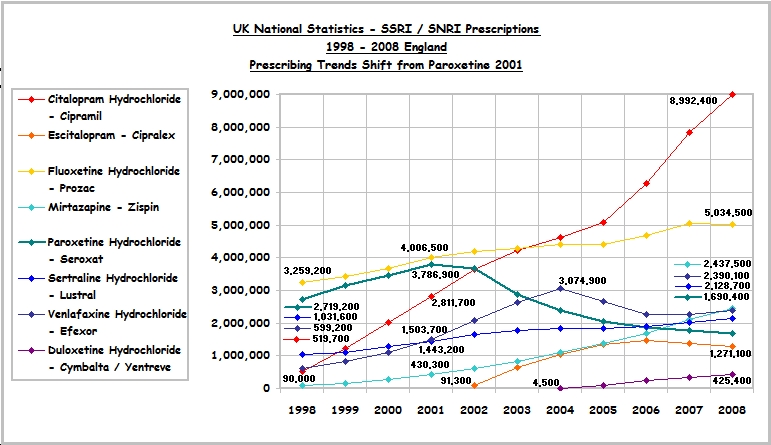
Prescribing Trends Shift from Paroxetine 2001


Click image to enlarge
http://farm4.static.flickr.com/3640/3492881456_528c138c6a_o.jpg

The marginal trend reversal of Paroxetine Total Prescriptions in 2001 correlates with: -

1 USA – August 2001, Paxil (Paroxetine / Seroxat) GSK class action Lawsuit filed in California Superior Court, LA County, USA.
http://www.onlinelawyersource.com/paxil/class-action.html


2 UK - The Guardian, December 10, 2001 article “Anti-depressant 'addicts' threaten legal Case”, publicises that solicitors Graham Ross of Ross & Co, Wirral, and Mark Harvey of Hugh James Ford Simey, Cardiff (Now Hugh James) who had liaised with American lawyers about Paxil are investigating the possibility of a UK Seroxat class action.
http://www.guardian.co.uk/uk/2001/dec/10/medicalscience.highereducation

The increase in the marginal trend reversal of Paroxetine Total Prescriptions in 2002 correlates with: -

3 UK – The Observer February 3, 2002 article “Hard habit to break”, Mark Harvey, of Hugh James Solicitors, Cardiff; instigates further publicity of the adverse drug reactions (ADRs), side effects and withdrawal problems, connected with the Seroxat --- but common to all drugs in the SSRI / SNRI class.

http://www.guardian.co.uk/Archive/Article/0,4273,4348653,00.html.

4 UK - The Observer, Sunday April 28 2002 “The chemistry of happiness“

http://www.guardian.co.uk/theobserver/2002/apr/28/features.magazine37

5 UK - The November 11th 2002 Parmjit Dhanda Early Day Motion, EDM 238 Seroxat, brought the drug and the SSRI issue to Parliament,

http://edmi.parliament.uk/EDMi/EDMDetails.aspx?EDMID=24050&SESSION=681


The acceleration of the marginal trend reversal of Paroxetine Total Prescriptions in 2003 correlates to: -


6 UK - The ensuing parliamentary questions, media coverage and MIND Seroxat Protest, May 12th 2003 at the MHRA London offices, which made national television news coverage

http://www.mind.org.uk/News+policy+and+campaigns/Press+archive/PRPanoramaSeroxat.htm

The Paroxetine prescribing trend continues to decline, all be it at a slower rate.

Significantly, the parliamentary interest and media coverage given to Seroxat and the continuing down trend in Paroxetine prescriptions has had NO impact on the overall marginal trend increases in prescription numbers for the drug class, although ALL are affected by the same ADRs, side effects and withdrawal problems."


into this


"New Blog from 'Anti-Seroxat Litigation Campaigner' "


"All, it seems, becomes abundantly clear toward the bottom of her blog, where it appears she has a grievance about the coverage Seroxat has been given in the media."


http://fiddaman.blogspot.com/2009/05/new-blog-from-anti-seroxat-litigation.HTML


(taken) - from Bob Fiddamans' "review" on his Seroxat Sufferers Blog, after disingenuously posting his comments under another post... presumably to draw attention away from the fact that the UK Government Price Cost (PCA) Statistics show irrefutably that Seroxat is the only drug in the SSRI, SNRI class that people can get and stay off!     

Professor Jon Jureidini psychiatrist paid Fiddaman's editing costs. Why? Why work with a proven liar?

"One person’s reported experience with a drug proves little but Fiddaman shows us what we can learn when we collect together the experience of many users. Patients’ collective experiences with their drugs constitute a gold mine of information for the health system and pharmaceutical industry, but we doctors and scientist make barely any effort to collect the data and make sense of it. It is left to small heroes like Bob Fiddaman to irritate the system. A more rigorous and informative examination of patients’ experiences with drugs could prevent countless crippling adverse events. If we do ever achieve a truly effective system of pharmacovigilance, then Bob Fiddaman’s blog will have played an important part in this outcome. "

source - http://fiddaman.blogspot.com/2011/04/seroxatpaxil-book-launched.html

Fiddaman said -


The Foreword is by Dr Jon Jureidini, child psychiatrist and clinical Professor, Discipline of Psychiatry, University of Adelaide, South Australia.

I owe Jon a great debt as it was he who set up the whole editing process [from Kindle version to paperback]

Here's his foreword. read on -