blogs created to prevent or detect a crime http://www.opsi.gov.uk/acts/acts1997/ukpga_19970040_en_1

This blog is brougt to you consistent with subsection 3 of the Protection from Harassment Act - i.e. blogs created to prevent or detect a crime http://www.opsi.gov.uk/acts/acts1997/ukpga_19970040_en_1


Monday, 7 March 2011

Sara Carlin - death by depression, cocaine and ethanol - jury concluded

The jury concluded that the cause of death was “hanging by ligature while affected by
 depression, cocaine and ethanol.”


Read more: http://www.blogger.com/goog_2022001387

Sunday, 6 March 2011

Give kids illegal drug 'in apple sauce', said Elan

Give kids illegal drug 'in apple sauce', said Elan


Firm paid for Caribbean and ski junkets for doctors

http://www.independent.ie/business/irish/give-kids-illegal-drug-in-apple-sauce-said-elan-2567660.html


Sunday March 06 2011


IRISH pharma giant Elan advised doctors to give an unauthorised drug to young children by mixing it in "apple sauce", according to documents obtained by the Sunday Independent.


Last Monday, the 3bn-valued Athlone-headquartered company agreed to pay the biggest fine in Irish corporate history, when it coughed up almost 147m as part of an agreement to resolve US criminal and civil investigations into the illegal marketing of an epilepsy drug.


The most shocking allegation made by the Justice Department is that Elan's sales force gave guidance about how to make children take the unapproved drug.


"One particular medical letter used by sales representatives with paediatricians described how to administer Zonegran to a child by putting the contents of a Zonegran capsule into apple sauce," according to the complaint.


"No mention was made of the fact that the FDA (Federal Drug Administration) had specifically not approved Zonegran for use in children due to the severe potential side effects..."


The case also revealed highly controversial methods used by drug companies to persuade doctors to prescribe their highly profitable products. Potential "high prescriber" doctors were invited on "expense-paid trips" to the Caribbean or ski resorts for "so-called" advisory board meetings to hear speeches on health issues. These junkets took place in Bermuda and Key Largo in Florida, as well as the exclusive Vail ski resort in Colorado and Tucson, Arizona, according to the allegations. Elan also sponsored presentations and articles about using Zonegran for unapproved purposes.


"Since the alleged actions occurred over six years ago, Elan has implemented a broad corporate compliance programme which follows guidance from global government authorities and is applicable to all aspects of the business," a spokesman said.


In 2000, Elan's drug Zonegran was approved by US authorities to treat patients over 16 years of age. It was the last of three new drugs brought on to the market by big pharma companies that year. It "faced a steep uphill battle to obtain sales", according to the filings. Two years later, Elan "came under significant financial pressure" because of an investigation into its financial practices by the US Securities and Exchange Commission. It undertook a review of its drug portfolio to decide which ones it would keep and which it could sell to raise cash.


"As part of that evaluation, Elan conducted market research and decided to retain Zonegran because of its large potential for growth, especially in unapproved uses," according to the US Justice Department. Elan promoted Zonegran to treat underage children suffering from mood swings, migraines and weight problems. This was hugely profitable for the drug company, with sales of the drug increasing dramatically.


The settlement is enormously embarrassing for some of the biggest names in the Irish business world as some of the best known corporate grandees served on the board over the period. These include former IDA Ireland boss Kieran McGowan, who is chairman of Ireland's biggest company, CRH. He joined the board in 1998. Tom Lynch, who served as the drug company's finance chief, has also been a board member of the IDA. Kyran McLaughlin is one of the joint heads of Davy stockbrokers, while Alan Gillespie served as chairman of Ulster Bank until 2008.


"Elan divested Zonegran in April 2004 and the activity under investigation dated originally to 2000, a time period which was prior to the majority of current management or directors respectively joining the company or the board," according to a spokesman for Elan.


- Nick Webb


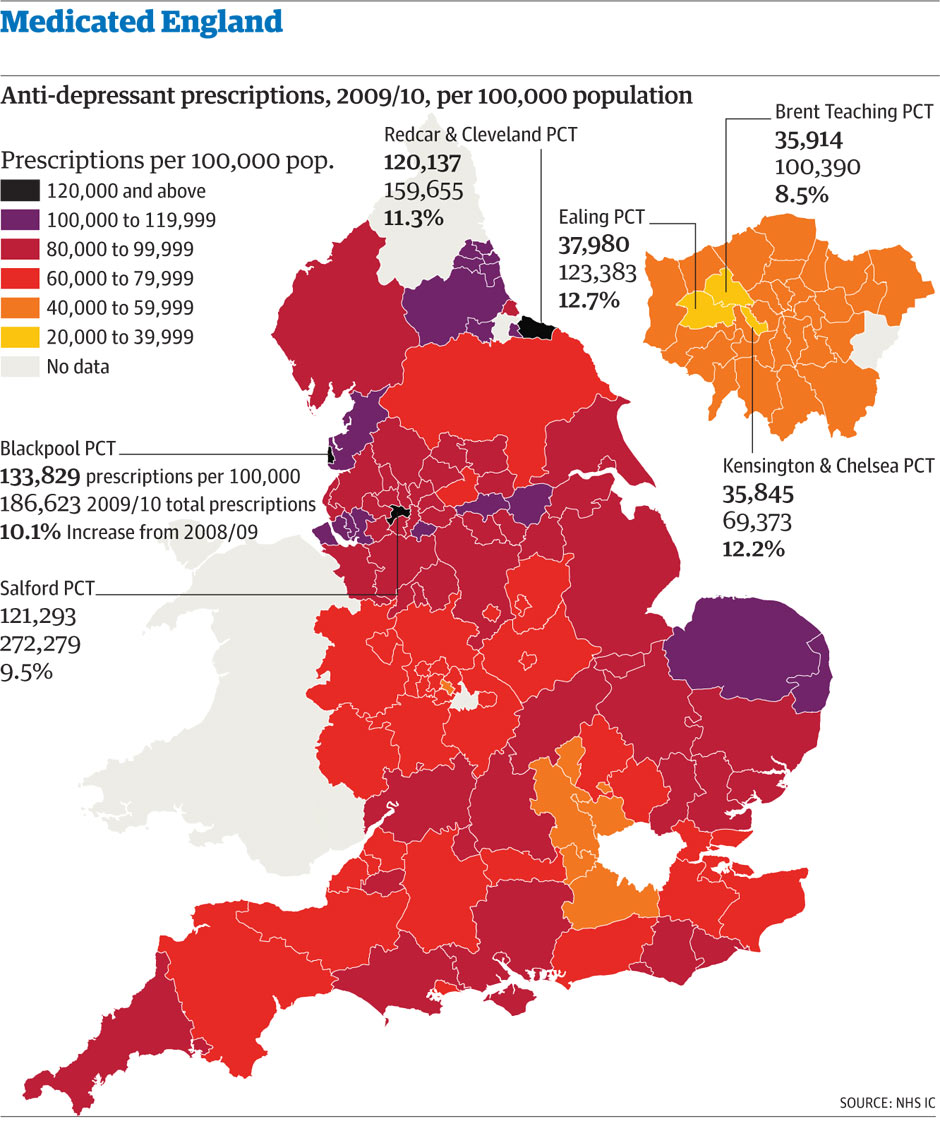
Antidepressants England rising @ up to 12.5% per year - full data here


How did we arrive at our figures? First, we gathered prescription data from the online database managed by the NHS Information Centre.


This quarterly information was compiled to get annual numbers covering 1 April 2009 to 31 March 2010 the most recent full year with available data. In order to make the numbers comparable, we then linked the raw prescription numbers to the ONS mid-year population estimates.


This allowed us to calculate the prescriptions per 100,000 figure in the data below, which controls for the different sizes of PCTs, if not their different levels of wealth, employment and general illness.


DATA: download the full spreadsheet


http://spreadsheets.google.com/ccc?key=0AonYZs4MzlZbdEhkM0hoaWVieC12Z1Z5VUtNc2tSeGc&hl=en#gid=0

Anti-depressants in England and Wales: a map of GP prescriptions

Saturday, 5 March 2011

PAXIL - yet another murderer tries to blame GSK's drug for his own failings !

COUNTY COURTHOUSE — A murder case with a lot of twists and turns since 2004 has at least one more twist in store.


http://www.dailyregister.com/news/police_and_fire/courts/x1512118192/Involuntary-intoxication-defense-introduced-in-2004-murder-case

James Burns, accused of murder in connection with the December 2004 death of Thomas Condon, plans to argue he was involuntarily intoxicated by the prescription drug Paxil at the time of the incident.


Burns' attorney, Hugh Richard Williams of Carbondale, served notice of "affirmative defense" on the court at a hearing Wednesday. The defense depends upon a medical expert reviewing the case and medical records of the defendant.


Burns pleaded guilty to the 2004 murder of Condon in 2006, but the plea agreement was sent back to Saline County Circuit Court after it was appealed to the Fifth District Appellate Court. Burns then filed a motion to withdraw his guilty plea on Dec. 5, 2008. That motion was granted Nov. 18, 2009, so the trial process has started again. An April 6 trial date was canceled; a status hearing will be held that day instead.


Williams took the case in January after Burns put together enough money to hire a private attorney instead of public defenders. Williams said he was "intrigued by the case" and took a fraction of his usual fee up-front to begin working on a defense.


Williams was allotted $500 by Judge Mark Clarke to have a doctor allowed to prescribe Paxil look over the case and see if further inquiry by an expert witness is necessary. The doctor who prescribed the drug, Dr. F. A. Munas, with the Veterans Administration, is now retired. He may be difficult to track down, although no effort has been made yet, Williams said.


In 2003, Burns was diagnosed with dysthymia, a chronic, low-grade form of depression that lasts years at a time. He was issued a prescription for 10 mg Paxil on Oct. 29, 2003. After telling personnel at the VA he "jumped out of a car and chased a guy," the dose was increased to 20 mg, according to court documents. Ten days later, on Dec. 11, 2003 the dose was doubled to 40 mg. He was also diagnosed with panic disorder on the same date. The list of medications he was using at the time include Paxil, Albuterol, butalbital, baclofen, flunisolide, gabapentin, naproxen and simvaastatin.


In June 2004, the VA did an assessment of Burns and found he posed no significant risk to himself even though he had a history of violence and impulsive behavior, according to court documents. Burns also received a homicide risk evaluation that consisted of asking him whether he planned to hurt anyone, according to court documents. During an evaluation or assessment of some sort, Burns told the VA he "goes off if the right buttons are pushed," and reported a verbal altercation.


When Burns withdrew his guilty plea in 2008, he successfully argued he did not understand the sentence fully - 45 years with no chance of early release and two years of parole - when he agreed to a guilty plea in 2006. Burns has said he did not understand he would have to serve 100 percent of the sentence.


Condon hired Burns to do some remodeling work in fall 2004, but the relationship apparently turned sour. Condon had filed a police report stating Burns had begun choking and punching him after a dispute over a white or gray counter top, according to the April 16, 2006 edition of the newspaper.

A neighbor called 9-1-1 on Dec. 10, 2004 and reported seeing Burns' truck around Condon's residence, former State's Attorney David Nelson said in 2006. Harrisburg Officer Terry Sisky told the neighbor in November 2004 to call if she saw Burns or his vehicle at Condon's house, but Sisky was not working Dec. 10,2004, Nelson said in 2006. On Dec. 21, 2004, the neighbor -- unidentified in the 2006 court hearing regarding the plea agreement -- called again and said Burns was at Condon's house. He was stopped by police but they had no reason to hold him at that time, Nelson said.


On Dec. 28, 2004, Condon's ex-wife asked police to check on Condon's welfare. She had not seen or heard from Condon in several days and was concerned about him, according to police reports. Police found Condon's body after noon the same day. Condon had been dead for some time.


Fiddaman, published author has to buy 30 copies of his own books from Chipmunka !

I do think it's a shame that their policy is now changed so that you don't get a physical copy of your book unless you choose to buy 30 copies (that's at a minimum cost of £360 if your book costs £10 x 30 + postage and packing). Now they are concentrating on ebooks unless you pay for the full service.

source -

http://www.absolutewrite.com/forums/showthread.php?t=92347&page=5

Chipmunka author sold thousands of copies but earned just £100


My memoir DARK CLOUDS GATHER that was published in 2008 sold thousands of copies - I was never given an exact figure. I was supposed to earn £1.50 per book, but if the buyer used a credit card then the 75p cost of this came out of my £1.50. Lordy knows what else went on. Well, I earned just under £100.


http://www.absolutewrite.com/forums/showthread.php?t=92347&page=5

Friday, 4 March 2011

Chipmunka gives a voice to mentally ill authors - Note that you shouldn't expect to make any money.

Quote:


Chipmunka Website:

I am excited about being published ? What should i expect ?


- Expect to be given a voice through your writing and being published

- See being published by us as recognition for you being recognised as a mental health or mental health educational/related artist.

- See being published by us as an opportunity to be recognised as a human being who can contribute to society, breaking down the stigma on mental illness and helping others have a voice.

- Expect to become part of a literary period in history that documents how people with mental illness, disability and carers give themselves a voice to improve the world in which we live and improve the lives of others.

- Expect to help others whenever a copy of your book is sold or you give an interview about your experiences.


Note that you shouldn't expect to make any money.


Chipmunka pricing levels are obscene - £20.00 - 450-600 pages !!

Quote:


Chipmunka Website:

Paperback pricing is as follows.


£10 - up to 200 pages

£12.99 - 200 to 300 pages

£15.00 - 300-450 pages

£20.00 - 450-600 pages

£25 - 600pages +


This is the RRP of books. Of course books may be sold cheaper by the book trade, especially online depending on how competitive the particular bookseller is. The pricing structure is reviewed on an annual basis by the Chipmunka team. See books on the Chipmunka website for pricing in different currencies. All pricing is standard. There are no exceptions.


Those pricing levels are obscene and I would suggest that in practice authors would have to discount to get people to buy their book.


http://www.absolutewrite.com/forums/showthread.php?t=92347

Chipmunka says don't come try to off social security benefits

Quote:


Chipmunka Website:

For advice on how much money you can receive on the benefits you are on please refer to the appropriate government website. Of course your royalties are paid annually and not weekly so you need to be aware of this. The Chipmunka Team cannot advise on this. We strongly recommend that nobody comes off benefits as a result of signing up with us.


I seriously hope that no one comes off benefits as a result of receiving a contract from this company because you are very unlikely to receive an amount sufficient to pay bills.

http://www.absolutewrite.com/forums/showthread.php?t=92347

Chipmunka books edited by volunteers

http://www.absolutewrite.com/forums/showthread.php?t=92347

Quote:


Chipmunka Website:

Chipmunka does edit books although not in as much detail as a traditional publisher. Chipmunka editors are volunteers and are either arts university students or retired editors. Chipmunka will look for repetition, potential legal, copyright issues and will look to correct typos in your book although the responsibility of the text remains with the author and how the quality in which they submit their book in the first place and when they sign off the text and cover at paperback stage.


So editing is at best cursory and there's the potential for your not having it edited by a professional

Chipmunka offers an extremely nonstandard contract - so NO big payday for Bob Fiddaman

Chipmunka offers an extremely nonstandard contract, including:


http://www.absolutewrite.com/forums/showthread.php?t=92347

- requiring authors to waive moral rights (Chipmunka is a UK-based publisher; the USA doesn't recognize moral rights, but they're an important part of copyright law in the UK and Europe)


- paying royalties on the publisher's net profit (actual cash receipts less production costs); this reduces royalties to a pittance


- taking rights for the life of copyright without adequate provisions for rights reversion


- paying royalties only once a year


- claiming a range of subsidiary rights there's no evidence they are able to exploit or license, and providing a nonstandard income split (just 20% of subrights income to the author).


There's more, but those are the highlights.


Chipmunka is a pretty narrowly focused niche publisher, so I would imagine it might have more success marketing its books outside the bookstore system than a publisher with a general publishing program. Nevertheless, bookstores are still an important outlet, and I don't see anything at Chipmunka's website to suggest it makes an effort to get its books into stores (it's also telling that the several royalty payment examples given in the contract don't include bookstore sales).


four-year-old on quetiapine therapy gets neuroleptic malignant syndrome after 3 weeks

Possible contribution of XYY syndrome to neuroleptic malignant syndrome in a child receiving quetiapine


http://www.ajhp.org/content/67/6/459.abstract


Timothy C. Randolph

+ Author Affiliations


Timothy C. Randolph, Pharm.D., is Clinical Pharmacy SpecialistEmergency Medicine, Pharmacy Services, Carolinas Medical CenterNorthEast, 920 Church Street North, Concord, NC 28025 (timothy.randolph@carolinashealthcare.org)

Abstract

Purpose A case of early neuroleptic malignant syndrome (NMS) in a child with XYY syndrome after three weeks of quetiapine therapy is reported.


Summary A four-year-old, 23-kg boy with a history of oppositional defiant disorder, mood disorder, and XYY syndrome was brought to the emergency care center (ECC) for evaluation secondary to somnolence, gait disturbances, and altered mental status. Three weeks prior, he was started on a daily oral dose of quetiapine 25 mg; this was adjusted upward to 400 mg daily. He had been experiencing episodes of severe confusion, somnolence, and extreme agitation. He was also ataxic and unbalanced on his feet. Upon evaluation at the ECC, he was found to have an elevated creatine kinase (CK) concentration, as well as elevated CK-MB and CK-MM levels, both of which were indicative of skeletal muscle damage. He was slightly diaphoretic and displayed mild rigidity accompanied by varying degrees of agitation and confusion. The diagnosis of NMS secondary to quetiapine therapy was made. Quetiapine was discontinued, and the patient was admitted for observation. His symptoms steadily resolved over the course of his hospital stay, and his total CK levels, as well as CK isoenzyme levels, fell over the course of observation. Quetiapine was not restarted at discharge, and no new medications were prescribed.


Conclusion A four-year-old boy with XYY syndrome developed signs and symptoms consistent with early NMS after three weeks of quetiapine therapy. High-dose quetiapine, along with possible baseline liver dysfunction secondary to XYY syndrome, may have contributed to the development of NMS in this patient, which resolved after the discontinuation of quetiapine.


Thursday, 3 March 2011

Teacher sacked for making stance ..... err more like serial trouble making

http://www.cchrint.org/2011/03/03/teacher-sacked-for-refusing-to-remove-have-you-drugged-your-kids-today-bumper-sticker/


teacher had a ‘laundry list’


of grievances against her including insisting on being called ‘Instructor Ausburn’ instead of ‘Ms Ausburn’.


She also claimed that she ripped up a test and gave the student a failing grade after the student said ‘God bless you’ to her when she sneezed.

School: Officials at Imagine Prep refused to comment on accusations that sacking Ms Ausburn over the sticker was a violation of the first amendment


from
http://www.dailymail.co.uk/news/article-1361834/Teacher-Tarah-Ausburn-sacked-drugged-kids-today-bumper-sticker.html?ito=feeds-newsxml


GSK offers to pay uni fees to attract fresh talent

GSK offers to pay uni fees to attract fresh talent


UK News
March 03, 2011

http://www.pharmatimes.com/Article/11-03-03/GSK_offers_to_pay_uni_fees_to_attract_fresh_talent.aspx

Selina McKee

Pharmaceutical giant GlaxoSmithKline has unveiled a new tactic to lure fresh talent into the company, promising to pick up the tab for new graduates' university education.


The drugmaker said yesterday that it would offer this extra financial support to graduates in order to help it "attract, recruit and retain the best talent and reflect the changing environment in the UK for students", at a cost of around £3 million a year.

It is anticipated that under new government proposals, some universities will be tripling tuition fees to around £9,000 a year, which means that students will be left with bills or around £27,000 (per three-year undergraduate degree) for their education alone.

Around 50-100 undergraduate students from various academic areas are recruited into the firm's UK Graduate Training Programmes or other roles every year, and those joining will be reimbursed their tuition fees when they start full employment, but are then be obliged to stay at the firm for a minimum of two years.

"The company believes these measures will help ensure that GSK remains a highly desirable place for graduates to consider working upon leaving university", it said in a statement, adding that its new recruitment drive will kick off in 2012, to mirror the government's timeline for raising tuition fees.


Charities win £25K

In other news at GSK, the IMPACT Awards, which it runs in partnership with The King's Fund, has seen 10 charities in the UK each winning £25,000 in recognition of their "outstanding contribution" to healthcare.


The awards provide a "vital source" of cashflow for the winners, particularly during the current era of austerity and budget pressures, and help to encourage innovation and good practice throughout the sector, the firm said.

The King's Fund's Lisa Weaks stressed the importance of recognising the contribution of charities to healthcare particular as health service reforms and spending cuts take place, as "their prevention and early intervention schemes are helping the NHS save money".

As well as receiving £25,000, the winners also get to attend a five-day development programme providing training, development and networking opportunities.


Fiddaman & Scientology - ROFLMAO

GSK Boss - Pay not affected by Avandia legal costs


LONDON, March 2 (Reuters) - GlaxoSmithKline (GSK.L) Chief Executive Andrew Witty's pay was cut by 734,000 pounds ($1.2 million) to 2.3 million pounds last year after Britain's biggest drugmaker missed its profit targets.


The shortfall followed plunging sales of controversial diabetes pill Avandia, which was withdrawn from the market in Europe last autumn and severely restricted in the United States after being linked to increased heart risk.


Witty received an unchanged base salary of 1 million pounds in 2010 but had his bonus reduced by 41 percent to 1.177 million from 2 million in 2009, GSK said in its annual report on Wednesday.


The big legal charges taken by GSK in 2010 -- partly to settle liability claims over Avandia and which wiped out the company's earnings in the fourth quarter -- were not included in the bonus calculation. (Reporting by Ben Hirschler; Editing by Will Waterman)

Paxil teen suicide - dignified parents make meaningful use of their grevious loss.

http://www2.scnow.com/news/grand-strand/2011/feb/18/marathon-runner-remembers-his-daughter-race-nears-ar-1481902/


On the outside he's a well trained marathon runner but on the inside is where Kevin Shroyer draws motivation to run races like this weekend’s.


In 1987 Kevin and his wife welcome their first born into the world - a bright eyed baby named Korinne.


“She was rambunctious, bubbly happy," Kevin said.


Korinne did well in school, had tons of friends, and was the goalie of her soccer team.


One day in 2002, she came to her parents with some concerns.


“Korinne came to her mother and I and said that she's been going through some mood swings and she would feel happy one day, sad the next day, kind of back and forth,” Kevin said.


Korinne began seeing a counselor and was recommended by a doctor to go on Paxil - an anti-depressant.


Ten days later the teen did the unexpected.


“I picked her up from school, brought her home, dropped her off and returned to work, and about an hour after that occurred she shot herself,” said Kevin.


Korinne died one week later, but in that week her parents decided to make her an organ donor. The very night of her death she saved another man's life - a man that she'd never even met.


Len Geiger was an athlete himself at one time.


Len was battling a rare and a potentially life threatening lung disease called Alpha 1.


After a successful lung transplant, Len took his first breaths with his new lungs.


“I think he's described it many ways, but it was almost like being born again,” said Kevin.


A year after the transplant Geiger and Shroyer met for the first time, and several months after that, the athlete with new lungs and the dad whose daughter provided them ran their first marathon together.


“It was emotional because I realized, you can't help but realize that this man is living and breathing and standing here beside me and we're doing a marathon together, and he's doing it all because of Korinne's lung donation to him,” said Kevin.


Hip problems prevent Geiger from running much now, but Kevin still runs marathons.


The Myrtle Beach race will be his 16th.


“Every race I run is in her memory, and the marathon, obviously being the ultimate race there is, road race there is, I can't think of any better race, any better distance to run in order to honor her memory than the marathon,” said Kevin.


Shroyer represents an organization called “Donate Life.”


The organ donation group has a website where you can donate to help them work to save lives like Len Geiger's.