blogs created to prevent or detect a crime http://www.opsi.gov.uk/acts/acts1997/ukpga_19970040_en_1

This blog is brougt to you consistent with subsection 3 of the Protection from Harassment Act - i.e. blogs created to prevent or detect a crime http://www.opsi.gov.uk/acts/acts1997/ukpga_19970040_en_1


Monday, 9 April 2012

PROZAC lawyers sue each other - whilst one Paul Smith becomes co defendant with Eli Lilly

http://bulk.resource.org/courts.gov/c/F3/101/101.F3d.1196.95-4060.95-3913.html


Carolyn G. WINKLER, Individually and as the Independent

Executrix of the Estate of Bernie A. Winkler, et
al., Plaintiffs-Appellants,
v.
ELI LILLY & CO. and Paul Smith, Defendants-Appellees. (parties)
Nos. 95-3913 and 95-4060.

PROZAC litigation secret deals - plaintiffs' counsel paid off by Lilly - FIDDAMAN blog

extract -


On May 23, 1996, the Kentucky Supreme Court decided the case of Hon. John W. Potter v. Eli Lilly unanimously in Judge Potter's favor, citing the lawyers' "serious lack of candor" and evidence of bad faith, abuse of process, even fraud. Although the court said that "the only result" of exposing the secret Fentress agreement "is that the truth will be revealed," the decision was less a victory for open settlements, and more a demand that the judge be included in the secret.


Judge Potter, though, still saw the larger issue. Armed with Supreme Court authority to conduct an investigation and hold a hearing, Potter asked Deputy State Attorney General Ann Sheadel to investigate, giving her the power to subpoena documents and question witnesses under oath. Sheadel's March 1997 report uncovered new twists to the story. A complex agreement did exist between Lilly and the plaintiffs, one so secret that it was never fully reduced to writing. All Sheadel could find was a written summary of the verbal agreement. No lawyer would admit preparing it, and no plaintiff was allowed to have it.


In exchange for the plaintiffs agreeing not to present the evidence of Lilly's criminal conduct with Oraflex, Lilly had agreed to pay all plaintiffs, win or lose. Part of the agreement was that all of chief plaintiffs' counsel Smith's Prozac cases, including those in Indianapolis, were settled, and half his overall expenses paid by Lilly.


read in full here - http://www.lectlaw.com/filesh/zbk03.htm

Adopted from pages 193-201 of The Moral Compass of the American Lawyer: Truth, Justice, Power, and Greed, © 1999, Richard Zitrin rzitrin@usfca.edu & Carol M. Langford langford@usfca.edu. All rights reserved.


This critically acclaimed book, about how the legal system allows lawyers to define "ethics" as what they can get away with rather than how they should behave, is written by two noted legal ethics professors who write frequently about ethics and morality in the legal profession.


From Melancholia to Prozac: A history of depression - book review on FIDDAMAN blog

QUEEN Victoria would have said she was grieving in proper proportion to her loss.


Today we would most likely diagnose her excessive mourning as "complicated grief disorder", and treat her accordingly: Pop a Prozac, Ma'am, and you'll feel better in the morning. No doubt Her Majesty would not be amused at such a crude attempt to rid her of her preferred state of melancholia.


Clark Lawlor, in his cultural history of depression and melancholia, commits much of the second half of the book to exploring the manner in which our present understanding of what constitutes mental illness has been influenced by drug companies keen to present doctors with simple definitions and even simpler "cures", the idea that a pill popped in the morning will make you healthy, wealthy and wise.


He quotes Ronald Wallace [on Prozac]: "So much happiness! It seems everything I touch shines back, all smiles."


But as many of us who have been filed under a "major depressive disorder" tag can attest, drugs like Prozac are not sufficient weaponry to combat what Churchill so famously called the Black Dog of depression. And beneath our need for quick fixes lies the question: do we now see normal human emotions, such as sadness, grief and loneliness as diseases that need to be medically treated?


And even those of us who, severely depressed, benefit from modern medications; do we really understand what the payback is? Probably not, argues Lawlor.


It was Aristotle, Lawlor tell us (or more likely one of his followers), who first made the irrepressible link between melancholia and supposed genius. The Aristotelian position stated: "Why is it that all men who have become outstanding in philosophy, statesmanship, poetry or the arts are melancholic ... .?"


Such a link, says Clark, went against the later Galenic notion of the sluggish and dull melancholic, a depressive overwhelmed by the darkness of the black bile -- or as 20th-Century psychiatry would have it; a person incapacitated by a chemical imbalance in the brain.


And certainly, while it might be nice to believe that our illness stems from an unrecognised genius, this is rarely the case.


Clark's analysis of depression/melancholia -- from Classical thought through to Renaissance, Romantic and Victorian interpretation --reveals how, despite our progress in neurobiology and psychiatry, we seem no nearer to understanding the intricacies of the mind; the links between extreme emotions and creativity and how they can teeter over into despair and destruction.


So where the Ancients would talk of "an imbalance of the humours; the more severe the imbalance, the more severe the symptoms of melancholia", the Romantics valorised a certain version of melancholia which served the needs of their creativity; "an excuse for meditative midnight excursions into the creative psyche, as well as a psychological space for envisioning social change".


By the 20th Century we had what was called the "New Depression", a chemical imbalance based on symptoms, and therefore more simply treated by a 'one size fits all' model.


Hopefully we are beginning to see attempts to forge a "model of the human that escapes the reductionism of biochemical definitions". The "New Melancholia" aims to treat the afflicted in a more holistic manner; acknowledging the usefulness of drugs like Prozac but admitting that the mind/body and the circumstances which affect it are just far too complicated to be amenable to a quick fix. This is the beauty and tragedy of the human condition.


- Clark Lawlor
http://www.independent.ie/entertainment/books/review-from-melancholia-to-prozac-a-history-of-depression-by-clark-lawlor-3074234.html


Sunday, 8 April 2012

Dietary Trans Fats Linked to Aggression - ** Exclusive on FIDDAMAN blog

Dietary Trans Fats Linked to Aggression


.
http://www.medscape.com/viewarticle/760978


The cross-sectional study of 945 adult men and women provides the first evidence linking trans-fat consumption to adverse behaviors that affect others. These range from impatience to overt aggression, lead author Beatrice A. Golomb, MD, PhD, from the University of California, San Diego, told Medscape Medical News.


Dr. Beatrice Golomb


"There were studies showing that omega-3 fatty acids were associated with increased agreeableness and reduced impulsivity, and there's evidence that trans fats adversely affect ability to create the long-chain omega-3 fatty acids that are favorable for your brain, and that prompted us to study this further," Dr. Golomb said.


The study was published online March 5 in PLoS One.


Universal Effect


The investigators used baseline dietary information and behavioral assessments to analyze the relationship between dietary intake of trans fatty acids and aggression or irritability.


The participants, who were seen between 1999 and 2004, were not on lipid medications and were without low-density lipoprotein (LDL) cholesterol extremes, diabetes, HIV, cancer, or heart disease.


The mean age of the participants was 57 years (range, 45 - 69 years), 68% were male, and 80% were white. The mean trans-fat consumption per day was 3.49 grams (range, 1.02 - 5.96 g/day).


The researchers collected nutrient data using a food frequency questionnaire; they collected information on behavioral acts of aggression toward self, others, and objects, with a variety of validated instruments, including the following:


•Overt Aggression Scale Modified – Aggression subscale (OASMa)

•Life History of Aggression (LHA)

•Conflict Tactics Scale (CTS)

•Impatience

•Irritability

They found that participants who ate more trans fats had higher scores on each of these measures.


"This was true for men and for women, across the age groups, people under 40, 40 to 60, and over age 60, and for Caucasians and minorities. In fact, this association across the different measures that we looked at was more consistent than with the other known predictors of aggression that we had access to, which were male, young age, and use of alcohol," Dr. Golomb noted.


Need to Eliminate Trans Fats


Karen Davison, PhD, RD, from the University of British Columbia, Vancouver, Canada, told Medscape Medical News that this study lends support to the evidence outlining the detrimental effects of artificial trans fatty acids, and also underlines the need to decrease them in the food supply.


"We need to keep in mind that food labels tend to not differentiate between manufactured and natural trans fats. These are chemically different, and research is needed to clarify the roles of each type on behavior," Dr. Davison said.


Olveen Carrasquillo, MD, MPH, chief of the division of general medicine at the University of Miami Miller School of Medicine in Florida, pointed out: "Since this was an observational study, one cannot definitively conclude that increased trans-fat consumption causes aggressive behavior. However, there is already substantial data from many other studies that high trans-fat consumption leads to a variety of poorer health outcomes, including heart disease and certain cancers."


Dr. Carrasquillo added that the findings from the study add to the evidence that individuals should try to limit their dietary trans-fat intake.


"The findings also support public health initiatives to limit trans-fat consumption. An example is New York City's initiative, which limits how much trans fat can be used by restaurants."


This research was supported by a grant from the National Institutes of Health. Dr. Golomb, Dr. Davison, and Dr. Carrasquillo have disclosed relevant financial relationships.


PLoS ONE. Published online March 5, 2012. Full article


Saturday, 7 April 2012

Interview with Maria Bradshaw - youtube statistics 65 listen to FIDDAMAN farting & burping 0.55 secs run

Drugs not best option for people at risk of psychosis, - news from FIDDAMAN blog

Drugs not best option for people at risk of psychosis, study warns Counselling and therapies effective in treating psychotic experiences that can lead to conditions such as schizophrenia


http://www.guardian.co.uk/society/2012/apr/06/drugs-psychosis-schizophrenia-counselling


The Guardian, Friday 6 April 2012 Article history

Anti-psychotic medicine aren't always the best choice and shouldn't be used as first option, study says. Photograph: INSADCO Photography /Alamy

Anti-psychotic medicine should not be the first option offered to people at risk of developing schizophrenia, researchers said on Friday.


Clinicians should be "extremely careful" about prescribing anti-psychotics to young people, because only a tenth will go on to develop more serious conditions, a study suggests.


The study by five universities found that "benign" psychological treatments, including Cognitive Therapy (CT), were effective in reducing the severity of psychotic experiences that can lead to conditions such as schizophrenia.


Published on the British Medical Journal website bmj.com, the study found the frequency, seriousness, and intensity of psychotic symptoms that may lead to more serious conditions was reduced by counselling and CT.


The landmark research could pave the way for coherent treatment for young people at risk of developing psychotic illnesses.


Teams from the universities of Glasgow, Birmingham, Cambridge and East Anglia, led by the University of Manchester, gave participants, aged between 14 and 35, weekly CT sessions for a maximum of six months, over a four year period.


They then monitored participants after treatment to track their symptoms.


Before the trial, international evidence estimated that 40-50% of people at risk of developing psychosis at a young age would progress to a psychotic illness.


But only 8% of patients in the study were shown to have made the transition.


Researchers said the results have led to suggestions that anti-psychotic medicine should not be the first option for young patients.


Professor Andrew Gumley, who led the research team at the University of Glasgow, said: "This study has very important implications for ensuring that young people who are at risk of developing psychosis are offered psychological therapy.


"Our findings that there is a much lower transition rate than previously found means that clinicians have to be extremely careful about prescribing anti-psychotics in this group since only one in 10 will actually develop psychosis."

Glaxosmithkline and Dainippon Sumitomo Pharma Japan - Co-Promotion Paxil CR - FIDDAMAN failed again

Glaxosmithkline and Dainippon Sumitomo Pharma Commence the Co-Promotion of Anti-Depressant Paxil CR Tablets


http://www.pharmalive.com/News/index.cfm?articleid=832721&categoryid=56

Share


TOKYO, March 30, 2012 - GlaxoSmithKline K.K. (President: Philippe Fauchet, Head Office: Shibuya-ku, Tokyo, hereinafter referred to as GSK) and Dainippon Sumitomo Pharma Co, Ltd. (President: Masayo Tada, Head Office: Chuo-ku, Osaka, hereinafter referred to as DSP) announce that the companies will commence the co-promotion of GSK’s anti-depressant Paxil® CR Tablets 12.5mg and Paxil® CR Tablets 25mg (paroxetine hydrochloride hydrate, hereinafter referred to as Paxil® CR) in Japan from April 1, 2012.


As announced on January 19, 2012, the two companies have already signed a "basic agreement". This time the two companies signed a "Co-promotion agreement". Under this agreement, effective April 1, 2012, GSK and DSP will co-promote Paxil® CR Tablets to medical institutions. GSK will deal with distribution and sales.


Paxil® CR is the controlled-release1 formulation of Paxil® tablets, an SSRI (selective serotonin reuptake inhibitor) anti-depressant. It received regulatory approval in Japan from MHLW on 18 January 2012 for the indication of depression and depressive state. Paxil® CR will be launched soon after insurance price has been decided. Overseas, development of anti-depressants using new formulation technology are being conducted actively and with the approval of Paxil® CR Tablets, Japan too has entered the era of controlled-release formulations. Paxil® CR Tablets was approved in the US in 1999 and as of June 2011, has been approved and widely used in over 40 countries worldwide.


Commenting on the co-promotion Philippe Fauchet, president of GSK, said, “GSK obtained marketing approval on Paxil®CR from the MHLW in addition to the existing Paxil® IR. By adopting new formulation technology Paxil® CR Tablets is expected to alleviate gastrointestinal symptoms in the early stages of administration of anti-depressants and contribute to improving the continuity of long-term treatment. Through the partnership with DSP, which has expertise and extensive experience in the psychiatry area, GSK hopes to contribute to the treatment of depression by further enhancing medical information provision to medical institutions regarding the drug's safety and efficacy.”


Masayo Tada, President and Chief Executive Officer, Dainippon Sumitomo Pharma Co., Ltd. commented, "We are working on the CNS area as one of our focus marketing areas and have developed promotional activities in this area including antipsychotic drugs. With this agreement, by adding Paxil® CR Tablets to our product line, we believe our activities can be expanded in the area of anti-depressants and we can further enhance our presence in the CNS area. We hope to contribute further to the treatment of depression by providing proper information to medical institutions in collaboration with GSK."


1

(Reference)

Profile of Paxil® CR

Product name

Paxil® CR Tablets 12.5mg, Paxil® CR Tablets 25mg

Generic name

paroxetine hydrochloride hydrate

Date of approval

18 January 2012

Indications

Depression and depressive state


Dosage and Administration

Usually for adults, paroxetine is administered orally at 12.5 mg as the initial dose once daily after evening meal, and the dose is subsequently increased to 25 mg a day taking a week or longer. Dosage should be adjusted according to symptoms and age in the dosing range not exceeding 50 mg a day and either of the above dose will be administered once daily after evening meal. When the dose is increased, it should be increased by 12.5 mg as a daily dose at intervals of a week or longer.

About Paxil® CR Tablets

First controlled-release anti-depressant in Japan, which has a slow pharmacokinetic profile by using formulation technology.


Using an enteric coating and two layer controlled-release technology 2, it is designed so that the drug is released gradually and continuously after it has left the stomach.


Compared to Paxil® IR Tablets, blood concentration increases gradually during single dose administration and as change in blood concentration during repeated administration is small, it is expected to reduce the risk of adverse events.


Overseas clinical trial3 ?4results have shown that treatment dropout due to adverse events do not differ greatly to placebo making it easy to take and it is expected to contribute to improving the continuity of long-term treatment.

1) Controlled-release formulation: Formulation using CR technology that controls drug release for continuous and gradual release

2?Two layer controlled-release technology. Paxil® CR Tablets is made up of 2 layers – an affinity matrix layer that includes active ingredients in the plain tablet (inner core) and an erodent barrier layer that does not include active ingredients, thereby controlling the rate of drug release.

3?Golden RN et al :J Clin Psychiatry,2002?63?7??577-584

4) Eaddy M, et al: Manage Care Interface,2003; 16(12 ): 22-7


Contacts:

Dainippon Sumitomo Pharma Co, Ltd. Corporate Communications

TEL?06-6203-1407

URL?http://www.ds-pharma.co.jp

GlaxoSmithKline K.K.

Corporate Communications

TEL?03-5786-5041

URL?http://glaxosmithkline.co.jp/


Friday, 6 April 2012

Planxty - Cliffs Of Dooneen

Christy Moore & Sinead O'Connor sweet thames flow softly

Christy Moore - Ride On

SSRI Suicide Dr David Healy was in correspondence with the MCA1999 - but FIDDAMAN suppressed this

Dr David Healy was in correspondence with the MCA by November 4th 1999 about the suicide issue and voicing concerns about the number of SSRIs being prescribed to children and adolescence,


“Both of these points, it seems to me, must be of concern to you. The issues are quite different to any problems that were ever raised in relation to benzodiazepine or SSRI dependence, where there is considerable ambiguity involved in deciding what constitutes dependence. In this case there are very clear internal company documents and a pattern of behaviour, possibly stemming from legal advice, that is inconsistent with prescription only arrangements.

Based on RCT evidence from a number of companies, epidemiological studies and other sources, at a conservative estimate I believe one person per week has killed themselves in the UK for every week that Prozac has been available over and above the number that would have done so if the same patients had been left untreated and one person per day has attempted suicide with unknown consequences for their future risk of suicide. I would be happy to go through this evidence with you, if this would help and indeed I would be happy to have the error of my ways pointed out if anyone can see a problem with my figures or logic.

Against the background outlined above, I feet particularly impelled to act as I am doing now in writing to you having been the convenor and author of a report on childhood psychopharmacology for the British Association for Psychopharmacology, which supported the prescription of psychotropic drugs to children and teenagers in appropriate circumstances and with appropriate monitoring. This document has not led directly to increased rates -of prescribing of SSRIs to adolescents in this country but it has done nothing to put a brake on what has been a dramatic increase in' recent years. Unfortunately, I now find my in-tray filling with files on teenagers committing suicide within a week or two of commencing Prozac. It is this that makes the problem difficult to walk away from.”

FIDDAMAN ** Exclusive - Press Release: Canada Narconon Victims File Complaints

Press Release: Canada Narconon Victims File Complaints


Submitted by intelligence on Apr 05, 2012 - 07:03 PM

Victims from across Canada have filed formal complaints against the Scientology drug treatment center, Narconon Trois-Rivieres. There are now seven victims from four Provinces who have filed their stories with the Quebec Ministry of Health and the Quebec Human Rights Commission - - two new complaints as recent as this week. David Edgar Love filed a formal complaint with the Quebec College of Physicians several months ago and the College banned Dr. Pierre Labonte from ever associating himself with Narconon Trois-Rivieres again.

WireService.ca Press Release - April 5, 2012 - The heat is being turned up on the controversial Scientology addiction treatment center, Narconon Trois-Rivieres in Quebec, Canada. Vulnerable victims who were duped into handing over tens of thousands to this unscrupulous organization, have had enough, as stated by one distraught victim today. Narconon is being investigated by the Quebec Ministry of Health and Social Services, Human Rights Commission, Canada Competition Bureau, Revenue Canada Charities Commission, and other government agencies, both Federal and Provincial.


Narconon Trois-Rvieres is the Scientology "Mother Ship" of addiction treatment centers in North America. The center has a capacity of 100 patients and has boasted a staff of over 80. With the recent media coverage, exposing the exploitation and abuses, the numbers at Narconon have dwindled to only a handful.


Complaints include Narconon using patients to do manual labour without renumeration - - some working long hours in the kitchen and other duties that paid staff normally do. Many staff walked off the job after not being paid for several weeks, leaving the patients ripe for exploitation.


Following a CBC TV Radio Canada undercover investigative report of Narconon Trois-Rivieres in April 2008, a new Quebec law stipulates that all residential addiction treatment centers in Quebec, must be Accredited. A certification committee is now investigating an application by Narconon Trois-Rivieres and reviewing thousands of pages of documents submitted by David Edgar Love and others, as well as from Narconon employee, Andre Ahern who is attempting to "handle" the situation.


Mr. Love and a member of Anonymous, Shadow, attended the office of Céline Hervieux-Payette at Parliament in Ottawa recently and spoke to the Senator about Scientology-Narconon in Quebec. The Senator has contacted authorities. On March 3, 2012, Emilie Dubreuil from the prominent newspaper Journal de Montreal, spread the story across two full pages about three of the Narconon victims and what they endured at the Cult rehab compound.


April promises to be a month of additional media exposure and as the victims push forward for justice, the government investigators dig for evidence to seal the fate of Narconon and their representatives.


David Edgar Love


Fiddaman & co delayed original investigation to get the unverifiable evidence accepted by the MHRA, for the purpose of getting LSC funding

Saturday, 18 December 2010


Seroxat Litigation - Report of the Committee on Safety of Medicines Expert Working Group on SSRI Antidepressants, 2004 - ‘Suicidal Behaviour in association with SSRI’

The previous and following excerpt of the Committee on Safety of Medicines (CSM) Expert Working Group (EWG) report “On the Safety of Selective Serotonin Reuptake Inhibitor Antidepressants” published December 2004 shows that the issue of withdrawal, dependence, suicidal and aggressive behaviour in associated with SSRI fluoxetine (Prozac) was under review with some gravity by the UK Medicine Control Agency (MCA) and CSM from 1990, referenced in MCA / CSM 'Current Problems in Pharmacovigilance', June 1992.


The review widened encompassing newer SSRI drugs when approved and licensed, close monitoring of spontaneous adverse drug reports (ADRs) lead to “a UK exercise in 1998 -2000 to develop harmonised safety information for all SSRIs”, acknowledging that all drugs in the class induced similar ADRs and side effects, and Dr David Healy’s 1999 publication ‘A Failure to Warn’ raised the level of concern in the issue of suicide and introduced SSRI induced akathisia - the now acknowledged precursor to suicidal ideation and action.


Dr David Healy was in correspondence with the MCA by November 4th 1999 about the suicide issue and voicing concerns about the number of SSRIs being prescribed to children and adolescence,


http://the-uk-seroxat-litigation-chronicles.blogspot.co.uk/2010/12/seroxat-litigation-report-of-committee.html

FIDDAMAN drowns out Lustral Sertraline Zoloft advice given on Mark Harvey (Hugh James) Seroxat User Group


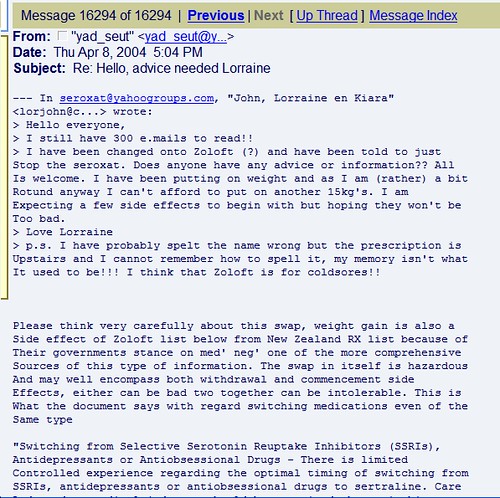
Lorraine, an active member of Derek Scotts SUG group was swapped from Seroxat to Lustral (sertraline) by her Gp so she posted to the group asking for advice; Scott's was a busy "support" group – April 2004 there were 1712 post, an average of 57 posts a day - 3 moderators and himself controlling it, all unemployed and usually on the group all day - yet the only reply she received was from another member Kevin, quoted above information and my initial response - see below


I waited to see if anyone would actually post advice or a cautionary warning …. 4 hours later concerned that Lorraine might swap thinking as no advice was forthcoming it would be safe to do so - I posted the following …


and was banned.


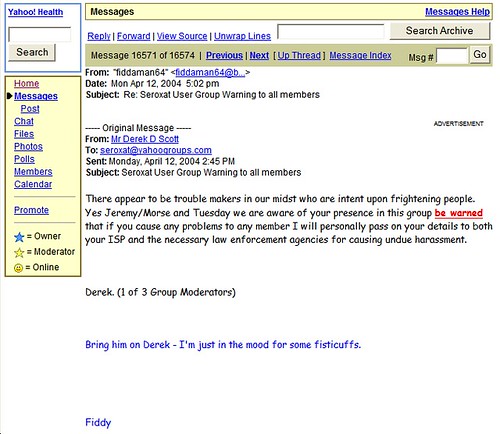
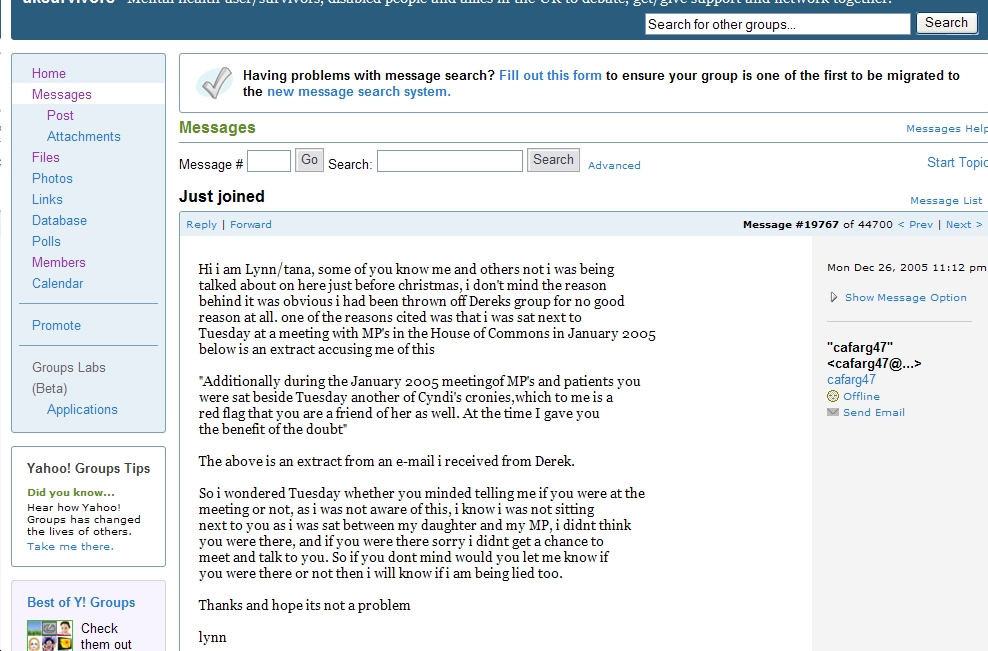
In the intervening three days before the following post appeared the vulnerable members were caused inordinate anxiety and distress by Jo Joseph (one of the moderators) and Cyndi White who kicked of their usual double act, whipping up a storm of fear, panic and paranoia reporting the presence of pharma troll, predators etc etc - accused me spamming them and of being Jeremy, Glitter and Catherine Creel, who they also viewed a threat – whilst Derek Scott and two other moderators Faye Elliott and Bob Fiddaman did nothing to advise Lorraine but encouraged the others – and group member and SUG co-ordinator Janice Simmonds, who's husband John was already taking Zoloft (sertraline, Lustral) and presumably unable to get off that either - ignored it all.


The following is Derek Scott and Bob Fidaman take on my posting that advice -


Thursday, 5 April 2012

Harvey having created the Seroxat User Group later claims he is not responsible - unbelievable, just like FIDDAMAN

Mark Harvey Hugh James set up seroxat "User Group" to form focus for litigation - in his own words FIDDAMAN

extract - http://www.blogger.com/goog_1782374033


Mark Harvey, a solicitor with the Cardiff firm Hugh James Ford Simey, has something to say on the subject: “My feeling is GSK knew, and they certainly know damn well now, their drug had the capacity to cause a lot of harm to small number of people. In particular in relation to coming off it and they’re not being honest to either prescribing doctors or patients.”

Hugh James Ford Simey has already been contacted by over 120 people, complaining of problems with Seroxat. They’re coming in, says Mark Harvey, at a rate of nearly three a week. In order to facilitate these people, the firm is setting up a ‘User’s Group’ to form the focus for future litigation against the drug companies. Many of these people have experiences ‘cold turkey’ like symptoms while coming off the drug.

“I’ve seen an advert in the States. It actually says ‘Talk to your doctor about non-habit forming Paxil,” says Harvey. “That’s outrageous, that’s clearly designed to catch patients and it deals with what they want to know, which is if it’s non addictive...”


FIDDAMAN tactic is to use mockery of someone to force an answer - but objects to his PARODY

"I usually find that making a mockery of someone or something is a good way of forcing an answer "

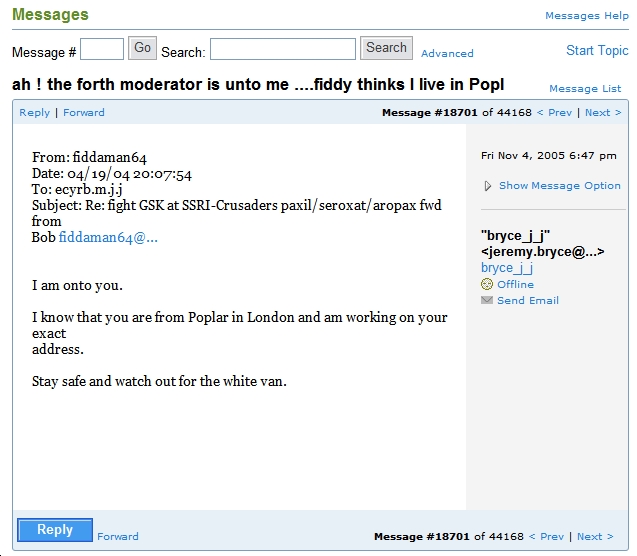
FIDDAMAN threats to send round "the white van" from as long ago as 2004 - it's all about control

@soulflsepulcher - an example of how two faced the FIDDAMAN & co campaign has become - it's all about control


see also - SoulfulSepulcher Twitter being used by Fiddaman ........it's all about control
http://bobfiddaman.blogspot.co.uk/2012/03/soulfulsepulcher-twitter-being-used-by.html