blogs created to prevent or detect a crime http://www.opsi.gov.uk/acts/acts1997/ukpga_19970040_en_1

This blog is brougt to you consistent with subsection 3 of the Protection from Harassment Act - i.e. blogs created to prevent or detect a crime http://www.opsi.gov.uk/acts/acts1997/ukpga_19970040_en_1


Tuesday, 8 February 2011

Efexor - Patient Information Update - Change due to harmonisation of PIL

Change due to harmonisation of PIL

http://www.medicines.org.uk/EMC/history/8609/XPIL/Efexor+XL


NEW PIL here - click to view document (pdf)

Wyeth Pharmaceuticals

Huntercombe Lane South, Taplow, Maidenhead, Berks, SL6 0PH
Telephone: +44 (0)1628 604 377
Fax: +44 (0)1628 666 368
Medical Information Direct Line: +44 (0)845 367 0098
Medical Information e-mail: EUMEDINFO@Pfizer.com
Medical Information Fax: +44 (0)845 367 0777


Antipsychotic Use in Dementia 1999-2007 - shows significant decline from 2003

Antipsychotic Use in Dementia 1999-2007


Helen C. Kales, MD; Kara Zivin, PhD; Hyungjin Myra Kim, ScD; Marcia Valenstein, MD; Claire Chiang, MD; Rosalindo Ignacio, MS; Dara Ganoczy, MPH; Francesca Cunningham, PharmD; Lon S. Schneider, MD; Frederic C. Blow, PhD


Arch Gen Psychiatry. 2011;68(2):190-197. doi:10.1001/archgenpsychiatry.2010.200


Context Use of atypical antipsychotics for neuropsychiatric symptoms of dementia increased markedly in the 1990s. Concerns about their use began to emerge in 2002, and in 2005, the US Food and Drug Administration warned that use of atypical antipsychotics in dementia was associated with increased mortality.


Objective To examine changes in atypical and conventional antipsychotic use in outpatients with dementia from 1999 through 2007.


Design Time-series analyses estimated the effect of the various warnings on atypical and conventional antipsychotic usage using national Veterans Affairs data across 3 periods: no warning (1999-2003), early warning (2003-2005), and black box warning (2005-2007).


Subjects Patients aged 65 years or older with dementia (n = 254 564).


Main Outcome Measures Outpatient antipsychotic use (percentage of patients, percentage of quarterly change, and difference between consecutive study periods).


Results In 1999, 17.7% (95% confidence interval [CI], 17.2-18.1) of patients with dementia were using atypical or conventional antipsychotics. Overall use began to decline during the no-warning period (rate per quarter, –0.12%; 95% CI, –0.16 to –0.07; P < .001). Following the black box warning, the decline continued (rate, –0.26%; 95% CI, –0.34 to –0.18; P < .001), with a significant difference between the early and black box warning periods (P = .006). Use of atypical antipsychotics as a group increased during the no-warning period (rate, 0.23; 95% CI, 0.17-0.30; P < .001), started to decline during the early-warning period (rate, –0.012; 95% CI, –0.14 to 0.11; P = .85), and more sharply declined during the black box warning period (rate, –0.27; 95% CI, –0.36 to –0.18; P < .001). Olanzapine and risperidone showed declining rates and quetiapine showed an increase during the early-warning period, but rates of use for all 3 antipsychotics declined during the black box warning period. In the black box warning period, there was a small but significant increase in anticonvulsant prescriptions (rate, 0.117; 95% CI, 0.08-0.16; P < .001).


Conclusions Use of atypical antipsychotics began to decline significantly in 2003, and the Food and Drug Administration advisory was temporally associated with a significant acceleration in the decline.


Author Affiliations: Department of Veterans Affairs, Ann Arbor Center of Excellence, Serious Mental Illness Treatment, Research, and Evaluation Center, Ann Arbor, Michigan (Drs Kales, Zivin, Kim, Valenstein, Chiang, and Blow and Mss Ignacio and Ganoczy); Department of Psychiatry (Drs Kales, Zivin, Valenstein, Chiang, and Blow and Ms Ignacio) and Center for Statistical Consultation and Research (Dr Kim), University of Michigan, Ann Arbor; Veterans Affairs Center for Medication Safety, Patient Safety Center of Inquiry, and Pharmacoepidemiologic/Outcomes Research, Hines, Illinois (Ms Cunningham); and the University of Southern California Keck School of Medicine, Los Angeles (Dr Schneider).


http://archpsyc.ama-assn.org/cgi/content/short/68/2/190

Antipsychotic Treatment and Brain Volumes - Longitudinal Study of First-Episode Schizophrenia

Long-term Antipsychotic Treatment and Brain Volumes


A Longitudinal Study of First-Episode Schizophrenia

http://archpsyc.ama-assn.org/cgi/content/short/68/2/128

Beng-Choon Ho, MRCPsych; Nancy C. Andreasen, MD, PhD; Steven Ziebell, BS; Ronald Pierson, MS; Vincent Magnotta, PhD


Arch Gen Psychiatry. 2011;68(2):128-137. doi:10.1001/archgenpsychiatry.2010.199


Context Progressive brain volume changes in schizophreniaare thought to be due principally to the disease. However, recentanimal studies indicate that antipsychotics, the mainstay oftreatment for schizophrenia patients, may also contribute tobrain tissue volume decrement. Because antipsychotics are prescribedfor long periods for schizophrenia patients and have increasinglywidespread use in other psychiatric disorders, it is imperativeto determine their long-term effects on the human brain.


Objective To evaluate relative contributions of 4 potentialpredictors (illness duration, antipsychotic treatment, illnessseverity, and substance abuse) of brain volume change.


Design Predictors of brain volume changes were assessedprospectively based on multiple informants.


Setting Data from the Iowa Longitudinal Study.


Patients Two hundred eleven patients with schizophreniawho underwent repeated neuroimaging beginning soon after illnessonset, yielding a total of 674 high-resolution magnetic resonancescans. On average, each patient had 3 scans (2 and as many as5) over 7.2 years (up to 14 years).


Main Outcome Measure Brain volumes.


Results During longitudinal follow-up, antipsychotic treatmentreflected national prescribing practices in 1991 through 2009.Longer follow-up correlated with smaller brain tissue volumesand larger cerebrospinal fluid volumes. Greater intensity ofantipsychotic treatment was associated with indicators of generalizedand specific brain tissue reduction after controlling for effectsof the other 3 predictors. More antipsychotic treatment wasassociated with smaller gray matter volumes. Progressive decrementin white matter volume was most evident among patients who receivedmore antipsychotic treatment. Illness severity had relativelymodest correlations with tissue volume reduction, and alcohol/illicitdrug misuse had no significant associations when effects ofthe other variables were adjusted.


Conclusions Viewed together with data from animal studies,our study suggests that antipsychotics have a subtle but measurableinfluence on brain tissue loss over time, suggesting the importanceof careful risk-benefit review of dosage and duration of treatmentas well as their off-label use.


Author Affiliations: Departments of Psychiatry (Drs Ho and Andreasen and Messrs Ziebell and Pierson) and Radiology (Dr Magnotta), University of Iowa Carver College of Medicine, Iowa City.


Schizophrenia Drugs May Lead to Brain Tissue Loss - Bloomberg

Anti-psychotic drugs from AstraZeneca Plc and Johnson & Johnson may lead to loss of brain tissue or exacerbate declines in brain volume caused by schizophrenia, a study in the Archives of General Psychiatry found.


http://archpsyc.ama-assn.org/


http://archpsyc.ama-assn.org/cgi/content/short/68/2/128

Researchers tracked 211 patients with newly diagnosed schizophrenia to determine if the progressive loss of brain tissue widely attributed to the disease may be affected by drugs to treat it, severity of the illness or substance abuse. More antipsychotic drug treatment, including duration and intensity, was linked to greater declines in brain volume. Severity of disease, alcohol and illegal drug use had no effect.


“What we found was that medication treatments are probably one of the contributing factors to brain volume declines we see in people with schizophrenia,” said lead researcher Beng-Choon Ho, a psychiatrist at the University of Iowa’s Carver College of Medicine in Iowa City. “It’s not a wise thing to jump to the conclusion that this is bad, although intuitively it seems like the first thing that people will conclude. In reality, we still don’t quite understand what it means.”


Patients shouldn’t stop taking their medicines, which include London-based AstraZeneca’s Seroquel, Risperdal from New Brunswick, New Jersey-based J&J, Indianapolis-based Eli Lilly & Co.’s Zyprexa and a host of older, generic medications, the researchers said. Instead, they and their doctors should find the lowest effective dose, Ho said in a telephone interview.


“Pharmaceutical companies must continue the vigorous search for agents that are genuinely neuroprotective,” the researchers said.


1 in 100


Schizophrenia is a mental disorder affecting about 1 in 100 people that makes it hard to distinguish reality, think logically and behave normally in social settings, according to the National Institutes of Health. Drug treatment helps control severe symptoms, such as hearing voices or violent outbursts. They also can produce side effects such as weight gain, diabetes, and movement disorders.


The researchers used repeated high-resolution magnetic resonance scans starting in 1990 to track changes in brain volume over time. Each patient had an average of three scans and was followed for more than seven years. The study didn’t include a comparison group of untreated patients, which would have been unethical, Ho said.


“It is possible that, although anti-psychotics relieve psychosis and its attendant suffering, these drugs may not arrest the pathophysiologic processes underlying schizophrenia and may even aggravate progressive brain tissue volume reductions,” the researchers concluded.


The study also raises concerns about the widespread and growing use of anti-psychotic drugs for people without schizophrenia, including the elderly and those with other mental disorders, the researchers said.


To contact the reporter on this story: Michelle Fay Cortez in Minneapolis at mcortez@bloomberg.net


To contact the editor responsible for this story: Reg Gale at rgale5@bloomberg.net


via bloomberg.com

Monday, 7 February 2011

SEROXAT litigant took day off from cold turkey for Casbah Club gig

Bob said


"The current UK Seroxat litigation, of which I am a claimant, will be the subject of future posts on this blog. I've remained quiet due to legal reasons but will be going public with revelations shortly. Both ITV and BBC have already approached me. "


to read a review of the Casbah Club  gig go here - http://www.bigcountry.co.uk/news/articleRead.php?id=18
 
to confirm Bob had day off from cold turkey go here -
http://groups.yahoo.com/group/uksurvivors/message/52355
 
to learn how FIDDAMAN tried to gag this information go here - http://chillingeffects.org/N/42559


PAXIL ADDICTION STORY - but Prof Healy's research shows PAXIL is the easiest to withdraw from

Sunday, 6 February 2011

FIDDAMAN could learn from Darcy Baston & grow up !

GAME OVER


http://paxilprogress.org/itstime.html


Darcy: 1, Paxil: 0

It's time. I have to go. There are giggling and ticklish things on my horizon that I have yet to touch. There are things I have to do before I can break ties, but the process has begun and should only take a couple weeks.


6 years ago, I had a problem. I was stuck on Paxil. I was just beginning to figure out that what I felt when I tried to reduce my dosage wasn't just a resurfacing of a current condition, but a new challenge called withdrawal.


I hated it.


I hated it then. Today, I'm completely and amorously grateful for it. That difficult challenge brought me through some incredibly rewarding growth, and the privilege of meeting all of you.


What you have all shown me since the inception of paxilprogress is that very few people believe how truly miraculous we all are, despite it being reality. We our own miracle waiting to be set free. We're heroes. In a world without validation nor an open ear, we walked forward hand in hand, trusting in our own abilities and achieved dream after dream. Like a set of dominoes where each weighed a million pounds, all we had to do was focus on toppling the first, and the rest began to spill effortlessly.


You also showed me that we each have our own first domino, and before we push on the collective one, we have to set our own in motion. You come first. Your first step is your step of change. You make it possible and give it to yourself. Once together, this happened Plunk. Plunk. Plunk-Plunk,Pl-Pl-Pl-P-P-P-P-P-P-R-R-RRRRRRRRRROAR.


The world took notice and change began; because of you, because of me, because of us. Thanks for teaching me how that works. Thanks for showing me how just by pushing one's own domino, a world is changed. All that is needed is consistent repetitive focused choice, and the rest just works itself out.


This happens when one takes the time to let go of needing to control the time it takes.


The act of letting go is magical like that. Most of us believe that things have to be pushed away, as if facing anxiety, depression or Paxil withdrawal is a battle. That couldn't be farther from the truth. All those things are nonsenses we've held closely to ourselves, and we have to let them go to be free of them. We've all noticed that takes quite a bit of effort. As convincing that is an argument for the "but it's a fight" idea, it's not that something is hard to let go of. It's that at the core of our beings, we are so devoid belief that we are the answer to ourselves, that we fight the walls we've put up. What you push through is not depression, but your construction of it. What you push through is not anxiety, but your mortar solidifying it. You've been brick building and have either not noticed, or are making yourself forget because that self imposed ignorance is what the world (friends, family, chance encounters, radio ad, media segment, doctor's counsel, whatever) has taught you to do.


I've been ignorantly fighting the idea of leaving paxilprogress. I had convinced myself it was difficult. My inner dialogue was full of: "But who will do what you've done? Does anyone have your experience with communities, forums, web servers, anxiety and Paxil? Will it take several people to replace you?" Etc. Andrea reminded me how egoic and silly all that was (and echoed by Laurie, Rita, Christie and more), and I was brought back from my little lull in wisdom. Change happens with letting go, and not while trying to control within a context of self identity. So whatever happens, however paxilprogress grows and changes, I have faith people will do what they can for each other with just as much passion, and let go. "Freedom is in you" MEANS letting go of rationalization and realizing that all is well, if you stop calling it unwell. And as backwards as that sounds when there are people getting hurt, it's just the necessary space to affect real changes that alleviate suffering.


read on - http://paxilprogress.org/itstime.html


FIDDAMAN took a "day off" from cold turkey withdrawal - what an insult to those who have genuinely suffered under SSRI's


"My blog is called Seroxat Sufferers because I took Seroxat and had a pretty torrid time with it. Your argument about me attending a concert during my cold turkey period was pretty lame - do you not think being stuck in a one-bedroom flat dealing with Zaps, sweats, anger etc warrants a day off?"


source - http://groups.yahoo.com/group/uksurvivors/message/52355


Scientology caused psychiatry to defend Lilly / Prozac - Prof David Healy


I launched into the influence of the Scientologists on the whole Prozac controversy. If they hadn’t intervened US psychiatry wouldn’t have stood behind Lilly the way it had.


source - www.healyprozac.com/Book/Chapter5and7.doc

BOB FIDDLING


SEEEE ! - ITS A BOB FIDDLING (nearby Dog Island of-course)


original here - http://groups.yahoo.com/group/uksurvivors/message/40863

Posttraumatic Embitterment Disorder: Definition, Evidence, Diagnosis, Treatment

Book Review


Posttraumatic Embitterment Disorder: Definition, Evidence, Diagnosis, Treatment

http://health.groups.yahoo.com/group/SSRI-Crusaders/message/34154
 
Michael Linden, a physician at the Seehof Rehabilitation Center in Berlin, saw an increasing number of patients with symptoms that he described with a new term: posttraumatic embitterment disorder. After Germany's reunification, Linden observed  an increase in the rates of reactive disorders. Several years later, patients continued to struggle with severe psychological reactions to negative life events. Linden and his colleges argue that such reactions cannot be classified as posttraumatic stress disorder, adjustment disorder, or even depressive disorder, and suggested posttraumatic embitterment disorder as a new reactive disorder.


Once Seroxat is removed, the great leader thinks it "will open the doors for other SSRi's to be thoroughly investigated "


I can see no benefit of Seroxat, none whatsoever. The longer it remains on the market will mean countless suffering for people on other SSRi's. Once removed, it will open the doors for other SSRi's to be thoroughly investigated and maybe other bloggers, campaigners, advocates can start banging the drum and asking the regulator about Prozac, Zoloft and other SSRi related drugs.

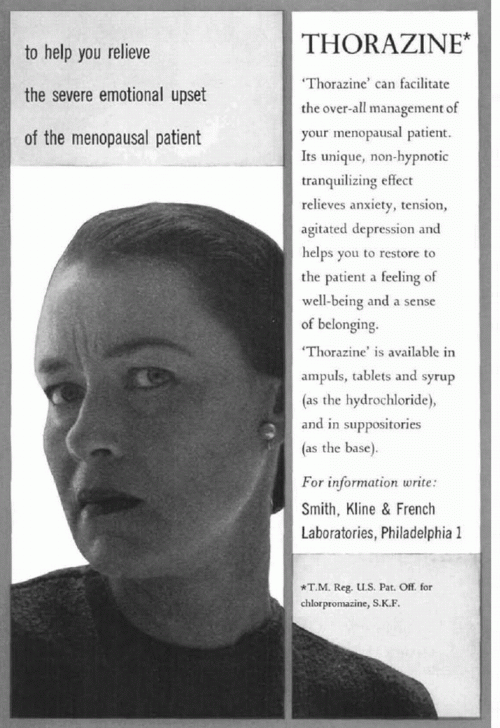
GSK * antipsychotic for menopausal patient 1956 advert - *Smith Kline & French Laboratories

Thorazine advertisement, 1956.


Psychosomatic Medicine, Vol. 8, No. 6.

to help you relieive
the severe emotional upset of the menopausal patient

THORAZINE*

'Thorazine' can facilitate the over-all management of

your menopausal patient. Its unique, non-hypnotic
tranquilizing effect relieves anxiety, tension, agitated depression and helps you to restore to the patient a feeling of well-being and a sense of belonging.

'Thorazine' is available in ampuls, tablets and syrup

(as the hydrochloride), and in suppositories
(as the base).
for information write:
Smith Kline & French Laboratories, Philadelphia 1
*T.M. Reg. U.S. Pat Off. for
chlorpromazine, S.K.F.

FIDDAMAN tried in vain to gag this post - so here it is, with original URL & photo

http://www.bigcountry.co.uk/news/articleRead.php?id=18

From: Bob Fiddaman Date: Thursday, 22 April 2004, at 5:38 pm


There isn't many concerts that can leave one feeling completely satisfied - well not since the days of Acca Dacca and Big Country. But wait......... we have the Casbah Club, a five peice set of muso's who probably have a combined age nearing the 300 mark.


With a sense of great anticipation, after reviews on this board, I got into the spirit of things with my buddy Arun and met a few familiar faces. Was surprised to see so much merchandise on sale and even more suprised to see the Big Country wooly hats - only wish I would have bought more funds so I could have purchased one.


For those of you that don't know, Bilston is a suburb of Wolverhampton and when we arrived, via the Metro tram, it seemed like a scene from the film 28 Days Later with empty streets and a few locals 'yim yammin' in the pubs.


The Robin 2 was a former temple for the Asian community but there was to be no praying tonight.


The support act were eye candy at best, their choice of songs not really hitting the spot. They have incredible talent and use harmonising vocals to great effect but they wasn't my cup of tea and I found their set quite 'sleepy', sorry girls.


The Casbah Club hit the stage some 15 minutes after the girls had left to the hypnotic backing tape of Eastworld - 'backing' being the operative word hear as it sounds as though it is being played backwards. The set was a trip down memory lane for BC and Jam fans alike. JJ announced that he had a sore throat and later told the audience the Bruce Foxton had also been ill to which the Winker responded 'He's had the shits'. The band was tight and the setlist most enjoyable - Brucie even gave me a couple of bars of AC/DC's 'It's A Long Way To The Top' after I shouted - 'BRUCIE, GIMME SOME MALCOLM YOUNG' - He and I are both of the same opinion that Malcolm Young is a great rhythm guitarist.


I disagree with Caroline's earlier post as I thought the venue was pretty packed - it was the stage floor that seemed rather sparse.


If you are in two minds as to whether you should go and see the CC then let me tell you that you will be pleasantly suprised by the passion shown by JJ - Where has this guy been hiding? He knows the songs word for word and plays and sings with a smile on his face - something we were so accustommed to with Stuart. He claimed to have a sore throat - it never showed. I have witnessed BC with Mike Peters and thought he complimented them well but JJ goes that one step further with his stage presence and energy.


Bruce Watson played solidly as ever and added a few one - liners along the way. Again, Bruce showed his great love for music and it was nice to see him play the lead breaks. The bloke never stands still so I don't know whether my photo's of him will turn out good - Slow down Brucie - before we know it you'll be wearing a schoolboy uniform and duck - walking across the stage!!!!


Mark was, well, Mark - playing as though he had been presented with a new drum kit. How on earth does he play faultless all the time?


Josh was rolling along nicely on the keyboards - the guy deserves a lot of credit for keeping things as tight as they were.


Bruce Foxton still looks 11 and his bass licks defy logic - last time I counted I had four fingers and a thumb on my right hand - the stuff he plays I would need at least 10 fingers on one hand!!!!


All in all a very entertaining night with some of the old favourites going down a treat. Chance was the highlight for me - close your eyes and you were back in the Barra's.


You did us proud lads - keep on rockin. I, for one, cannot wait for some new material and shall be knocking on Mr Grant's door for my order.


Thanks - all 5 of you for a great night.


Fiddy


Chapter structure - in due course the team here @ Bob Fiddaman blog will look at more plausible explanations

The evidence, however, is clear...the Seroxat scandal,
Chapter 1: Highway to hell

Chapter 2: Cold turkey

Chapter 3: A chemical imbalance: the serotonin myth

Chapter 4: Meet with me Mr Woods, part I

Chapter 5: The Yellow Card Scheme

Chapter 6: GlaxoSmithKline

Chapter 7: When the rot set in at GlaxoSmithKline

Chapter 8: Remove your video ... or else!

Chapter 9: Sara and Sharise

Chapter 10: Meet with me Mr Woods, part II

Chapter 11: The meeting and the influence of blogs

Chapter 12: It’s one big game

Chapter 13: Rob Robinson

Chapter 14: Brand name confusion

Chapter 15: The kids are alright

Chapter 16: You scratch our backs and ... we won’t scratch yours!

Chapter 17: GlaxoSmithKline Guilty

Chapter 18: Is Seroxat a teratogen? Goodbye MHRA

Chapter 19: Show me the way to Puerto Rico: the Glaxo whistleblower

Chapter 20: Field of dreams: the SSRI scandal

Chapter 21: Only in America

source - http://www.feedage.com/feeds/533955/seroxat-sufferers-stand-up-and-be-counted

Saturday, 5 February 2011

FIDDAMAN tried but failed to GAG this blog - why, what was he trying to hide?

July 8, 2010


http://chillingeffects.org/N/42559

Sender Information:

Bob Fiddaman

Sent by:

n/a


GB
Recipient Information:
Google, Inc. [Blogger]


Mountain View, CA, USA


Sent via: online form
Re: Infringement Notification for Blogger

Web Form DMCA Complaint Submitted for: n/a

YOUR COPYRIGHTED WORK
Location of copyrighted work (where your authorized work is located):

http://bobfiddaman.blogspot.com/


What is the copyrighted work?:
Photographs


LOCATION OF INFRINGING MATERIAL
Location (URL) of infringing material in the catalog.
Too many posts to mention - many in the sidebar


This one -

https://blogger.googleusercontent.com/img/b/R29vZ2xl/AVvXsEivjSEvb0M7IIjhZdeL9gcgPy8G2rU35qtTXaQt3euHSOHOCPAwfGg2J-IWDBDsq7rZcLzKfBC6T-ToYa2xe9cwvEKAhRi7LGQFc3Ut1C7BftYbFqM595ioGT1DDe-m9tss4iTLMhQGDEA/s320/Fiddy+paranoid+eyes.jpg


links to work that is copyrighted.


This one -

https://blogger.googleusercontent.com/img/b/R29vZ2xl/AVvXsEgar-VoAd_ACLwcEinLQBMgdlJ_60fEe3VvX4gPQ3yHQXGt2ZfYjMJrtIVMCYw0caDIUpduwkMFpy62Ajz0WrSfXnMOP8jlJ1FKTI_EimBIWz7S_rqxQaTf2BCsr1w-zWX5_1mvGOcuEnQ/s1600-r/Photo-0029+(2).jpg


was taken from my Facebook account

https://blogger.googleusercontent.com/img/b/R29vZ2xl/AVvXsEjGWVOqNUhnsBkxEBBV0dPB-LB8RnFtVErl-I7G3x5vJ5ZJaYPLV4oYNx4BNIZoLnmixcdnd61KDbbiTwQGJzZpwn8nbLGuo5q8YtY3fdPd0-gCruL3HNrMfOLiIv8_Pm3MJ93zwAJwGJA/s1600/arun+fid.jpg


https://blogger.googleusercontent.com/img/b/R29vZ2xl/AVvXsEhoLT7IDCHZZMNHGbFOEK4Z6vTaxvRmB0xJPmofCnyx4bLttIL3-7Qgz-yy9_yx2a6Hlm5IRuBRFLtlRBPYLk_1xVxYleY0r27HoARG9J2Vnu0bDa90su1mesl2VKhqeaRQU-meSTeRE-9L/s748/11.JPG


Many of the above images, as well as others appear throughout this person's
blog.

It is basically a shadow blog of my own.


Shadow Blog - http://bobfiddaman.blogspot.com

My blog - http://fiddaman.blogspot.com


I have wrote about this individual here -

http://fiddaman.blogspot.com/2010/07/inquest-of-sara-carlin-and-moderation.html


Location (URL) of infringing third party content that the blog is linking to.

http://fiddaman.blogspot.com/2010/07/sara-carlin-inquest-setting-record.html


http://findarticles.com/p/news-articles/sunday-mercury-birmingham-england/mi_7995/is_2004_June_27/letter-drug-danger/ai_n37255173/


http://www.bigcountry.co.uk/news/articleRead.php?id=18


http://bobfiddaman.blogspot.com/2010/06/paroxetine-induced-increase-in-activity.html


Sworn Statement

I have a good faith belief that use of the copyrighted materials described above as allegedly infringing is not authorized by the copyright owner, its agent, or the law. [checked]


I swear, under penalty of perjury, that the information in the notification is accurate and that I am the copyright owner or am authorized to act on behalf of the owner of an exclusive right that is allegedly infringed. [checked]


Signature


Signed on this date of:

8th July 2010


GSK is healthy, and it's not just the drugs - share buyback and the promise of future growth make GSK a solid buy


the story of GlaxoSmithKline's annual results is a lesson in the art of managing expectations. The headline figures were less than cheery – the drug maker booked a fourth-quarter loss of 7.5p per share before major restructuring, against forecasts of 6p per share – but the stock firmed up, despite yesterday's falling market.


Though it may seem odd at first, the reaction was down to the fact that the drug-maker had already flagged up a massive £2.2bn fourth-quarter legal charge weeks before the results. Analysts had already run the numbers and were expecting the provision to wipe out the earnings for the three months to December, which it did.


The City was also expecting the charge to push back the resumption of share buybacks. But, the day before the results, GSK unveiled the sale of its stake in quest diagnostics in a cool $1.7bn deal. Soon there was talk that the company could well pull a rabbit out of the hat, and it did, announcing a new long-term share buyback and raising its dividend.


And this isn't mere spin. Few companies can digest a massive legal hit and still resume a buyback. Fewer still can boast of growth in tough markets such as the US. Chief executive Andrew Witty has spent the past couple of years turning GSK into something more than a mere pharma company, making the research and development process more efficient and throwing resources at the consumer arm. These moves promise to keep GSK on a strong footing as the industry deals with growing competition from generics. He deserves credit, as does the stock, which trades on undemanding multiples of about 11 times forward earnings.


The combination of the recent weakness in the share price – it was down nearly 9 per cent over January – the share buyback and the promise of future growth make GSK a solid buy

http://www.independent.co.uk/news/business/sharewatch/investment-column-gsk-is-healthy-and-its-not-just-the-drugs-2203806.html

GSK results go down well with investors

GSK results go down well with investors


World News
February 04, 2011


Kevin Grogan


The markets have reacted well to GlaxoSmithKline's financials, in part due to the resumption of a share buyback and signs that the company is doing well in the tough US market.

Although profits for the fourth quarter were battered by a £2.17 billion charge relating to fresh legal battles concerning its diabetes drug Avandia (rosiglitazone) and an investigation into its marketing practices in the USA, investors welcomed the news that GSK will restart its share buyback programme this year, the first time since 2008.


The drugs major plans to repurchase between £1-£2 billion of stock and the buyback announcement came a day after GSK sold its stake in Quest Diagnostics to Deutsche Bank and JP Morgan for $1.7 billion, which after tax comes to $1.1 billion. Chief executive Andrew Witty noted that "divestments of non-core assets to create value for shareholders will continue". That process has begun with Valeant Pharmaceuticals International buying the NorthAmerican marketing rights to the cold sore treatment Zovirax (aciclovir) for $300 million.

http://www.pharmatimes.com/Article/11-02-04/GSK_results_go_down_well_with_investors.aspx


Mr Witty added that as well as increasing the dividend or buying back shares, its pot of cash could be used “where returns are more attractive", to "invest in bolt-on acquisitions". He said he is particularly interested in emerging markets, vaccines and consumer health.


Seroxat "has made me a danger" - Bob Fiddaman states in letter to Sunday Mercury

Seroxat "has made me a danger" - Bob Fiddaman states in letter to Sunday Mercury


Letter: Drug has made me a danger

Sunday Mercury (Birmingham, England), June 27, 2004


I READ with great interest the story of Faye Elliot from Gloucestershire regarding her plight with the antidepressant Seroxat. I, like Faye, am part of the Online Seroxat Support Group and have had horrendous side-effects from this so-called 'wonder drug'.


Fortunately, I am now Seroxat-free, coming off the drug 'cold turkey' over four months ago. This was my fourth attempt to come off after being prescribed them by my GP over six years ago.


During those six years, I made one suicide attempt, separated from my wife and three children and lost my job. The effects have had a devastating effect on my life.


Seroxat has changed me as a person -I no longer wish to be in social situations because I fear for the safety of whoever says the wrong thing to me.


A lot of my anger is vented toward the company that manufacture the drug, Glaxo SmithKlein (GSK), for their lies and deceit on the general public.


This anti-depressant should be banned immediately whilst there is a public inquiry.


The frustration and anger inside me grow each day, particularly recently as there have been many stories regarding people's struggles with this demon drug.


I do not blame the GPs or psychiatrists - they have been kept as much in the dark as the patients. Something needs to be done and it needs to be seen to be done with immediate effect otherwise there will be more stories of suicide or homicidal tendencies.


I hope one day that the powers-that-be at GSK and the Medicines and Healthcare products Regulatory Agency (MHRA), a board set up to grant licences to pharmaceu-tical companies, are force-fed this drug for a six-week period -then taken off it. Let's see them suffer the electric-like zaps through the body, the profuse sweating, the bouts of insomnia, the bouts of parasomnia, the rage and fury. Let them lose their wife and kids, their job, their friends, their sanity.


I applaud the Sunday Mercury for shedding light on this matter.


The Online Seroxat Support Group can be contacted via fiddaman64@blueyonder.co.uk


BOB FIDDAMAN Quinton Birmingham


These Popular Drugs Can Make You Violent

These Popular Drugs Can Make You Violent - http://j.mp/h9aA04