http://docs.google.com/viewer?a=v&q=cache:KX0QeE_tJ1oJ:www.healyprozac.com/Trials/Tobin/Transcripts/BEAMAN%2520LETTER.LTR%255B1%255D.DOC+paxil+gag+order&hl=en&gl=uk&pid=bl&srcid=ADGEESivmKm1Bro4qfwoGzxK-cX5cDq91q9tl2xdz-d-aBK7d5YKLJyUrdduu1vUTnvLRe7XiMEzYr_M2G1vE8l4yqM-fIMI8omWy8-TS9gRyZ4xlhgNRtRtsTS44VI7TysTnY-igCf1&sig=AHIEtbTnM-wESB4NtFC-pT9VcgzyICrIQQ&pli=1
www.healyprozac.com/Trials/.../BEAMAN%20LETTER.LTR%5B1%5D. DOC
http://webcache.googleusercontent.com/search?q=cache:KX0QeE_tJ1oJ:www.healyprozac.com/Trials/Tobin/Transcripts/BEAMAN%2520LETTER.LTR%255B1%255D.DOC+paxil+gag+order&hl=en&gl=uk
Vickery & Waldner, llp
ATTORNEYS AND COUNSELORS
A N D Y V I C K E R Y T H E A M E R I C A T O W E R T E L E P H O N E: (7 1 3) 5 2 6 - 1 1 0 0
P A U L W A L D N E R
2 9 2 9 A L L E N P A R K W A Y , S U I T E 2 4 1 0 F A X: (7 1 3) 5 2 3 - 5 9 3 9
O F C O U N S E L
R I C H A R D W . E W I N G H O U S T O N , T E X A S 7 7 0 1 9 W W W . J U S T I C E S E E K E R S . C O M
May 13, 2001
Honorable William C. Beaman
United States Magistrate Judge
P.O. Box 268
Cheyenne, Wyoming 82003-0268
FAX to 307-772-2898
Re: Civil No. 00-CV-025D; Tobin and Schell v. SmithKline Beecham
United States District Court, District of Wyoming
Report on Contact and Heads Up Regarding Foreign Journalists
Dear Judge Beaman:
Please forgive the informality of this letter communication. However, it has been prompted by a phone conversation between myself and Mr. Zvoleff1 late Friday afternoon, and is sent in anticipation of a request by SKB on Monday morning for a phone conference with the Court, at which time it is my understanding that SKB will ask the Court to broaden its oral gag order to include a prohibition against a citizen of the United Kingdom talking to British and Canadian journalists about issues of intentional importance, which also are extremely germane to his own career. Before that conversation takes place, I would like the Court to be aware of the background, and of our perspectives. I would also like to report to the Court on my own compliance with the Court’s Order, in a manner which, I hope, will de-emphasize rather than intensify publicity about the trial of this specific case.
As the Court is aware, the question of SSRI induced violence and suicide has, from time to time, generated significant journalistic interest. Over the last year, that interest has increased. Both the Boston Globe and the Indianapolis Star have run series of articles. The Guardian and other papers in the UK have also run a series of stories. The BBC did an excellent radio documentary, and television stories have also run on 20/20 and elsewhere. A specific 60 Minutes segment focusing on the Miller case is slated to run sometime in the future (although I do not now believe that it will air before or during this trial).
As one of the very few lawyers who are litigating these cases against the SSRI manufacturers, I have been frequently contacted by media representatives. Because one of my clients’ goals is to educate the public and protect other families from similar tragedies, because I personally believe that there is a small minority of vulnerable patients who are at increased risk of violence and suicide as a result of these drugs, and because I am an unabashed and unapologetic advocate for First Amendment rights, I have generally cooperated with media representatives regarding these matters. My partner and I also make certain public documents available on our website, www.justiceseekers.com. 2
As the Court might well expect, with over $7 billion in annual sales at stake, the SSRI manufacturers have generally done everything within their power to discourage publicity, to “pooh-pooh” plaintiffs’ allegations and to decry the opinions of folks like David Healy as “junk science”, in public as well as in the courtroom. On one occasion, i.e. in the Miller case, they sought court intervention in the form of a “gag order”. A copy of Judge Vratil’s order denying Pfizer’s motion for such a “presumptively unconstitutional” order is attached to this letter.
With the exception of the forthcoming trial of this case, one of the most newsworthy events in recent months has been the public revelation that David Healy lost a prestigious job in Toronto because of his outspoken stance on these issues and his participation as an expert witness on behalf of victim/families. It has been front page news in Toronto within the last month, and, as the Court well knows, a Canadian news documentary on “academic freedom”, focusing specifically on the Healy case, is under production. Other news stories are being written about this matter, and it is entirely possible that comments given by me before this Court’s Order will be quoted in those stories.
SKB will file its motion in limine on Monday morning, seeking to exclude any reference in this trial to Dr. Healy’s loss of job in Toronto. I have discussed the matter thoroughly with local counsel, Mr. Fitzgerald, and he and I both believe that, once the Court sees our reply on Tuesday or Wednesday (when due), you will understand and appreciate why these matters are extremely relevant to the trial of this case.
In the meantime, we all have a case to try, and the Court has made its position regarding public comments by officers of the Court abundantly clear. In light of your Order, in as nice a way as humanly possible, I canceled my scheduled interview with the Canadian television crew. I did not tell them that the Court had issued a “gag order” because, in my experience, saying something like that to a member of the Fourth Estate is like tossing bloody meat into shark infested waters.3
Protection of First Amendment rights was one of my main responsibilities as a lawyer for the Secretary of the Army in the mid-70's, and I frequently wrote that, although military men have such rights, the exercise of those rights may be reasonably restricted as to “time, place and manner”. As an officer of this Court, I accept the Court’s imposition of such restrictions on me and my comments as the Court deems appropriate.
Yesterday morning I received a telephone call from a man who identified himself as a London reporter. He asked me a couple of times about the status of the Tobin trial and other pending Paxil cases, and, other than telling him that the pleadings were a matter of public record and the case was going to trial on May 21st, I simply responded that I had chosen to focus my energies on the trial and would have no public comments to make about the case until after the verdict. After that call was put through, I advised my staff to screen all calls, and, if they come from journalists interested in SSRI matters to tell them that I will have no public comments on these cases until the Tobin verdict.
Yesterday afternoon Mr. Zvoleff advised me that SKB officials in London had received a media inquiry there. Presumably it came from the same journalist who called my office. There are a number of media angles and interests, separate and apart from the trial of this case. For example, there is a particular interest in Paxil in the UK because (1) it is the best selling SSRI in the UK, (2) it is produced by a British company, (3) there is considerable evidence tending to indicate that it causes dependence (always a big thing for the Brits I am told), and (4) the most outspoken critic of the SSRI oligopoly, Dr. Healy, is a prominent member of the British psychopharmacologic community.
Another issue of journalistic interest in the UK is the fact that SKB’s former director of safety, Dr. Ian Hudson, who will testify via deposition in this case, is now a government regulator. Mr. Zvoleff expressed concern that, perhaps, this call came as a result of some action on Dr. Healy’s part. He indicated that SKB would seek an order from this Court on Monday, extending its “gag” restrictions to Dr. Healy.
Although we would have grave reservations about the constitutionality of any gag order which extended beyond the parties and their counsel, we will, of course, comply with any instructions the Court gives us, including an instruction to advise a British subject, designated as a witness in this case, from discussing these matters in public. However, for the record, we believe that it would be, not only inappropriate, but also unconstitutional, for the Court to enjoin the free speech rights of an Irish citizen, living in Wales, and talking to Canadian or London journalists about matters of public interest, inter alia, in Toronto. As Judge Vratil noted in the Miller opinion, there is little reason to believe that news articles in foreign countries will pollute the jury pool in Cheyenne. And there are less restrictive means of dealing with that issue.
I hope that this letter will put some of these matters into perspective for the Court. I will be available for a conference call at anytime on Monday that the Court deems appropriate.
Respectfully,
Andy Vickery
Enclosure as stated
cc:
Charles F. Preuss, Esq.
Vern Zvoleff, Esq.
Preuss Shanagher Zvoleff & Zimmer
225 Bush Street, 15th Floor
San Francisco, California 94104
FAX to (415) 397-1735
Thomas G. Gorman, Esq.
Ms. Misha Westby
Hirst & Applegate, PC
1720 Carey Avenue, Suite 200
PO Box 1083
Cheyenne, Wy 82003-1083
FAX to 307-632-4999
James E. Fitzgerald, Esq.
2108 Warren Ave.
Cheyenne, Wyoming 82001
FAX to 307-635-2391
Tuesday, 11 January 2011

STOP THE LIES ABOUT SEROXAT/PAXIL
STOP THE LIES ABOUT SEROXAT/PAXIL it really is the fastest declining SSRI of all time !
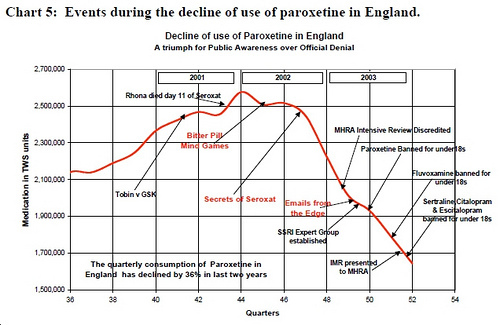
source - http://the-uk-seroxat-litigation-chronicles.blogspot.com/
source - http://the-uk-seroxat-litigation-chronicles.blogspot.com/
Monday, 10 January 2011
GSK Quislings - What are your thoughts on people who took the money and kept quiet?
http://www.topix.com/forum/drug/effexor/TSFN5FNS6NV52E02G
What are your thoughts on people who took the money and kept quiet? I mean the ones who know the dangers and suffering Ads cause that's been proven in a court of law.
This has been on my mind as I know there are people who have sued an won withdrawal claims to do with paxil prozac and others. In order to get the money they had to sign a gag order. Judges had to ok this drug companies and their lawyers were all on board… all these people knew we were going to suffer.. they did nothing to help us. To warn us. Many other cases of antidepressant damages have been settled the exact same way.
People took the money and ran screw the who came after them. Good thing the fellows who fought to free the jews in Germany during the ww2 did not think the same way if they did I guess we would all be speaking German.
What kind of a world are they leaving their kids what responsibility to we have to each other and human beings? Do we owe and common decency respect responsibility to our fellow human beings. Am I a Neanderthal for thinking we do?
As the daughter of a ww2 vet who never knew her father and grew up without because of it I think I have paid and my family has paid the price. Are we just fools in this new age of every man for himself.
Am I that out of touch.
I am truly having a problem with this. Where does it end.
My question is would you take the money and run knowing the truth about antidepressants would be kept quiet if you did and that many millions more would come after you and suffer lose everything and some would for sure die. The bodies may not be on tv being bulldozed into hole but they are there quietly piling up in the consciousness of the people who know. Nothing stays hidden forever.
Take the money or not.
If you like add some thoughts as to what you think of the people who took the money the judges lawyers ect that ok it the people at pharma that endorsed it.
At the end of the day all these are people choices made ideas scams if you will all thought of and carried out by people. What do you make of the willingness to hurt others to further a career get more money.
All thoughts welcome
What are your thoughts on people who took the money and kept quiet? I mean the ones who know the dangers and suffering Ads cause that's been proven in a court of law.
This has been on my mind as I know there are people who have sued an won withdrawal claims to do with paxil prozac and others. In order to get the money they had to sign a gag order. Judges had to ok this drug companies and their lawyers were all on board… all these people knew we were going to suffer.. they did nothing to help us. To warn us. Many other cases of antidepressant damages have been settled the exact same way.
People took the money and ran screw the who came after them. Good thing the fellows who fought to free the jews in Germany during the ww2 did not think the same way if they did I guess we would all be speaking German.
What kind of a world are they leaving their kids what responsibility to we have to each other and human beings? Do we owe and common decency respect responsibility to our fellow human beings. Am I a Neanderthal for thinking we do?
As the daughter of a ww2 vet who never knew her father and grew up without because of it I think I have paid and my family has paid the price. Are we just fools in this new age of every man for himself.
Am I that out of touch.
I am truly having a problem with this. Where does it end.
My question is would you take the money and run knowing the truth about antidepressants would be kept quiet if you did and that many millions more would come after you and suffer lose everything and some would for sure die. The bodies may not be on tv being bulldozed into hole but they are there quietly piling up in the consciousness of the people who know. Nothing stays hidden forever.
Take the money or not.
If you like add some thoughts as to what you think of the people who took the money the judges lawyers ect that ok it the people at pharma that endorsed it.
At the end of the day all these are people choices made ideas scams if you will all thought of and carried out by people. What do you make of the willingness to hurt others to further a career get more money.
All thoughts welcome
Music 'releases mood-enhancing chemical in the brain'
Music releases a chemical in the brain that has a key role in setting good moods, a study has suggested.
http://www.bbc.co.uk/news/health-12135590
The study, reported in Nature Neuroscience, found that the chemical was released at moments of peak enjoyment.
Researchers from McGill University in Montreal said it was the first time that the chemical - called dopamine - had been tested in response to music.
Dopamine increases in response to other stimuli such as food and money.
It is known to produce a feel-good state in response to certain tangible stimulants - from eating sweets to taking cocaine.
Dopamine is also associated with less tangible stimuli - such as being in love.
In this study, levels of dopamine were found to be up to 9% higher when volunteers were listening to music they enjoyed.
The report authors say it's significant in proving that humans obtain pleasure from music - an abstract reward - that is comparable with the pleasure obtained from more basic biological stimuli.
Music psychologist, Dr Vicky Williamson from Goldsmiths College, University of London welcomed the paper. She said the research didn't answer why music was so important to humans - but proved that it was.
"This paper shows that music is inextricably linked with our deepest reward systems."
Musical 'frisson'
The study involved scanning the brains of eight volunteers over three sessions, using two different types of scan.
Continue reading the main story
“
Start Quote
This paper shows that music is inextricably linked with our deepest reward systems”
End Quote
Dr Vicky Williamson
Goldsmiths College, University of London
The relatively small sample had been narrowed down from an initial group of 217 people.
This was because the participants had to experience "chills" consistently, to the same piece of music, without diminishing on multiple listening or in different environments.
A type of nuclear medicine imaging called a PET scan was used for two sessions. For one session, volunteers listened to music that they highly enjoyed and during the other, they listened to music that they were neutral about.
In the third session the music alternated between enjoyed and neutral, while a functional magnetic resonance imaging, or fMRI scan was made.
Data gathered from the two different types of scans was then analysed and researchers were able to estimate dopamine release.
Dopamine transmission was higher when the participants were listening to music they enjoyed.
Consistent chills
A key element of the study was to measure the release of dopamine, when the participants were feeling their highest emotional response to the music.
To achieve this, researchers marked when participants felt a shiver down the spine of the sort that many people feel in response to a favourite piece of music.
This "chill" or "musical frisson" pinpointed when the volunteers were feeling maxim pleasure.
The scans showed increased endogenous dopamine transmission when the participants felt a "chill". Conversely, when they were listening to music which did not produce a "chill", less dopamine was released.
Continue reading the main story
What is dopamine?
Dopamine is a common neurotransmitter in the brain. It is released in response to rewarding human activity and is linked to reinforcement and motivation - these include activities that are biologically significant such as eating and sex
Dr Robert Zatorre said: "We needed to be sure that we could find people who experienced chills very consistently and reliably.
"That is because once we put them in the scanner, if they did not get chills then we would have nothing to measure.
"The other factor that was important is that we wanted to eliminate any potential confound from verbal associations, so we used only instrumental music.
"This also eliminated many of the original sample of people because the music they brought in that gave them chills had lyrics."
http://www.bbc.co.uk/news/health-12135590
The study, reported in Nature Neuroscience, found that the chemical was released at moments of peak enjoyment.
Researchers from McGill University in Montreal said it was the first time that the chemical - called dopamine - had been tested in response to music.
Dopamine increases in response to other stimuli such as food and money.
It is known to produce a feel-good state in response to certain tangible stimulants - from eating sweets to taking cocaine.
Dopamine is also associated with less tangible stimuli - such as being in love.
In this study, levels of dopamine were found to be up to 9% higher when volunteers were listening to music they enjoyed.
The report authors say it's significant in proving that humans obtain pleasure from music - an abstract reward - that is comparable with the pleasure obtained from more basic biological stimuli.
Music psychologist, Dr Vicky Williamson from Goldsmiths College, University of London welcomed the paper. She said the research didn't answer why music was so important to humans - but proved that it was.
"This paper shows that music is inextricably linked with our deepest reward systems."
Musical 'frisson'
The study involved scanning the brains of eight volunteers over three sessions, using two different types of scan.
Continue reading the main story
“
Start Quote
This paper shows that music is inextricably linked with our deepest reward systems”
End Quote
Dr Vicky Williamson
Goldsmiths College, University of London
The relatively small sample had been narrowed down from an initial group of 217 people.
This was because the participants had to experience "chills" consistently, to the same piece of music, without diminishing on multiple listening or in different environments.
A type of nuclear medicine imaging called a PET scan was used for two sessions. For one session, volunteers listened to music that they highly enjoyed and during the other, they listened to music that they were neutral about.
In the third session the music alternated between enjoyed and neutral, while a functional magnetic resonance imaging, or fMRI scan was made.
Data gathered from the two different types of scans was then analysed and researchers were able to estimate dopamine release.
Dopamine transmission was higher when the participants were listening to music they enjoyed.
Consistent chills
A key element of the study was to measure the release of dopamine, when the participants were feeling their highest emotional response to the music.
To achieve this, researchers marked when participants felt a shiver down the spine of the sort that many people feel in response to a favourite piece of music.
This "chill" or "musical frisson" pinpointed when the volunteers were feeling maxim pleasure.
The scans showed increased endogenous dopamine transmission when the participants felt a "chill". Conversely, when they were listening to music which did not produce a "chill", less dopamine was released.
Continue reading the main story
What is dopamine?
Dopamine is a common neurotransmitter in the brain. It is released in response to rewarding human activity and is linked to reinforcement and motivation - these include activities that are biologically significant such as eating and sex
Dr Robert Zatorre said: "We needed to be sure that we could find people who experienced chills very consistently and reliably.
"That is because once we put them in the scanner, if they did not get chills then we would have nothing to measure.
"The other factor that was important is that we wanted to eliminate any potential confound from verbal associations, so we used only instrumental music.
"This also eliminated many of the original sample of people because the music they brought in that gave them chills had lyrics."
Sunday, 9 January 2011

Saturday, 8 January 2011
Seroxat litigation collapsed ??? .... "suffice to say that hundreds of people have been severely let down"
http://shutah.wordpress.com/
I’m back …
Posted by shutah on January 8, 2011
Hello all,
Recent correspondence received has prompted me to write again on the ever-present issues surrounding Seroxat (and other SSRI’s).
Did anyone watch Silent Witness (2nd/3rd Jan)? Was it bravery on the part of the BBC to highlight SSRI’s or perhaps a point to be well made? It’s been several years since Shelley Joffrey’s Panorama programme investigated the mis-prescribing of Seroxat to under-18′s and the dreadful, well-documented outcome of those actions.
Since then, like many others, I have been closely following the current litigation against GSK and am utterly disgusted with our judicial system. I’m not going into detail, but suffice to say that hundreds of people have been severely let down by our so-called ‘justice’ system!!!
A question I’d like to ask – is there anyone out there who has been taking Seroxat on a long-term basis? I’m coming into my 16th year hooked on this hideous drug and cannot seem to find any information/advice on the long-term use of SSRI’s. Any suggestions please?

I’m back …
Posted by shutah on January 8, 2011
Hello all,
Recent correspondence received has prompted me to write again on the ever-present issues surrounding Seroxat (and other SSRI’s).
Did anyone watch Silent Witness (2nd/3rd Jan)? Was it bravery on the part of the BBC to highlight SSRI’s or perhaps a point to be well made? It’s been several years since Shelley Joffrey’s Panorama programme investigated the mis-prescribing of Seroxat to under-18′s and the dreadful, well-documented outcome of those actions.
Since then, like many others, I have been closely following the current litigation against GSK and am utterly disgusted with our judicial system. I’m not going into detail, but suffice to say that hundreds of people have been severely let down by our so-called ‘justice’ system!!!
A question I’d like to ask – is there anyone out there who has been taking Seroxat on a long-term basis? I’m coming into my 16th year hooked on this hideous drug and cannot seem to find any information/advice on the long-term use of SSRI’s. Any suggestions please?

Wednesday, 5 January 2011
Sarah Venn - what did they do with the donations ??
Sarah Venn advises me there is no bank account for me to pay funds into - Claire Doherty > Red.ordead@ntlworld.com
 -----Original Message----- > From: red.ordead@ntlworld.com [mailto:red.ordead@ntlworld.com] > Sent: 30 June 2003 01:12 > To: andrew@seroxatusergroup.org.uk; ABennett@bluepumpkin.com; > trish@canutewalk.fsnet.co.uk; sarah@seroxatusergroup.org.uk; > lydia@hastingsdiving.com; charliegreig@hotmail.com > Subject: urgent seroxat user group > > Dear committee member, > I would like to donate money to the group. > Sarah Venn advises me there is no bank account for me to pay funds into > Why? > What is happening to the online donations? > Why in six months has a bank account not been opened? > It is vital to the running of the group > I have grave concerns about the groups management > Also the site has now exceeded its bandwidth so members will not be able > to access it. > > This bank account needs to be open, otherwise how can we make donations > and how can the group continue, with such limited funding. This is a > grave worry to me as the seroxat user group is my life line and many > other members too. > I can honestly say without it I wouldnt be here. > Please can you get this sorted > I look forward to your response > > Yours hopefully > Claire Doherty > Red.ordead@ntlworld.com > >

Sarah Venn barrister's firm Halliwells face £10m liability to banks
Halliwells partners could face £10m joint liability to banks
Author: Claire Ruckin
http://www.legalweek.com/legal-week/news/1720050/halliwells-partners-gbp10m-joint-liability-banks-deal-sell-business-falls
01 Jul 2010
00:05
 3 comments
Law firms: Halliwells Spectre of administration raises possibility that partners could be liable for millions in capital contributions
Existing and former Halliwells partners may find themselves jointly liable for around £10m owed to the national firm's banks as it moves to thrash out a deal to transfer the business.
Halliwells' banks collectively lent partners around £10m to fund capital contributions, which the law firm confirmed it is unable to pay back. Usually a law firm undertakes to pay the loan - which is taken out by partners and put into the firm on entering the equity - back to the bank on the partner's departure. However, lenders could now turn to individual partners to recover what they are owed.
In addition to initial capital loaned by Royal Bank of Scotland (RBS) to partners on entering the equity, a number of partners could find themselves liable for loans taken out for a 2008 capital injection. Equity partners were asked to double their capital in the firm, borrowing the money from Swedish bank Handelsbanken. At the same time, fixed-share partners were asked to contribute between £10,000 and £20,000 each.
This means in total some partners could be liable to pay back loans of hundreds of thousands of pounds.
A number of ex-partners have expressed concern that they will potentially be left bankrupt if the banks seek to recover the money. If this is the case, many will not be able to remain in their new firms' partnership as UK laws and the majority of partnership deeds require automatic expulsion of personally insolvent partners.
Halliwells, which filed a notice of intention to appoint an administrator last Thursday (24 June), is currently in discussions with a number of firms to sell off all or part of the business. It is understood that RBS hopes to secure around £12m from the sale of the firm. Halliwells' corporate debt with RBS currently stands at £17.7m.
Hill Dickinson, which is in detailed discussions to take over the majority of Halliwells' business and is the only firm to set out a formal offer so far, has offered to repay the bank a portion of the capital owed as part of the deal.
If Halliwells and Hill Dickinson cannot come to an arrangement it is likely that Halliwells will look to sell off parts of the business to a number of firms. Barlow Lyde & Gilbert (BLG) is understood to have expressed an interest in taking on Halliwells' 100-strong insurance team for £5m.
The firm is hoping to agree a sale without having to enter into a long process of administration, working with accountants BDO Stoy Hayward to consider its options. Currently there is a moratorium on Halliwells' liabilities, and the firm has up to 10 working days from the point of filing notice to find a buyer. However, the firm could extend this deadline by filing rolling notices.
Halliwells said in a statement: "Halliwells LLP is in advanced discussions for the transfer of the business to another highly-regarded firm of solicitors due to events that have adversely impacted the finances of the firm. The underlying business remains strong and has attracted interest from a number of parties."
Hill Dickinson and BLG declined to comment.
Separately, it has emerged that Halliwells laid off its seven-lawyer London real estate team at the end of May, including two partners.
Additional reporting by Sofia Lind.
Author: Claire Ruckin
http://www.legalweek.com/legal-week/news/1720050/halliwells-partners-gbp10m-joint-liability-banks-deal-sell-business-falls
01 Jul 2010
00:05

Law firms: Halliwells Spectre of administration raises possibility that partners could be liable for millions in capital contributions
Existing and former Halliwells partners may find themselves jointly liable for around £10m owed to the national firm's banks as it moves to thrash out a deal to transfer the business.
Halliwells' banks collectively lent partners around £10m to fund capital contributions, which the law firm confirmed it is unable to pay back. Usually a law firm undertakes to pay the loan - which is taken out by partners and put into the firm on entering the equity - back to the bank on the partner's departure. However, lenders could now turn to individual partners to recover what they are owed.
In addition to initial capital loaned by Royal Bank of Scotland (RBS) to partners on entering the equity, a number of partners could find themselves liable for loans taken out for a 2008 capital injection. Equity partners were asked to double their capital in the firm, borrowing the money from Swedish bank Handelsbanken. At the same time, fixed-share partners were asked to contribute between £10,000 and £20,000 each.
This means in total some partners could be liable to pay back loans of hundreds of thousands of pounds.
A number of ex-partners have expressed concern that they will potentially be left bankrupt if the banks seek to recover the money. If this is the case, many will not be able to remain in their new firms' partnership as UK laws and the majority of partnership deeds require automatic expulsion of personally insolvent partners.
Halliwells, which filed a notice of intention to appoint an administrator last Thursday (24 June), is currently in discussions with a number of firms to sell off all or part of the business. It is understood that RBS hopes to secure around £12m from the sale of the firm. Halliwells' corporate debt with RBS currently stands at £17.7m.
Hill Dickinson, which is in detailed discussions to take over the majority of Halliwells' business and is the only firm to set out a formal offer so far, has offered to repay the bank a portion of the capital owed as part of the deal.
If Halliwells and Hill Dickinson cannot come to an arrangement it is likely that Halliwells will look to sell off parts of the business to a number of firms. Barlow Lyde & Gilbert (BLG) is understood to have expressed an interest in taking on Halliwells' 100-strong insurance team for £5m.
The firm is hoping to agree a sale without having to enter into a long process of administration, working with accountants BDO Stoy Hayward to consider its options. Currently there is a moratorium on Halliwells' liabilities, and the firm has up to 10 working days from the point of filing notice to find a buyer. However, the firm could extend this deadline by filing rolling notices.
Halliwells said in a statement: "Halliwells LLP is in advanced discussions for the transfer of the business to another highly-regarded firm of solicitors due to events that have adversely impacted the finances of the firm. The underlying business remains strong and has attracted interest from a number of parties."
Hill Dickinson and BLG declined to comment.
Separately, it has emerged that Halliwells laid off its seven-lawyer London real estate team at the end of May, including two partners.
Additional reporting by Sofia Lind.
Tuesday, 4 January 2011
Fiddaman refuses to pay MHRA for F.O.I. research for his book - The Evidence is clear
source
http://fiddaman.blogspot.com/2007/03/transparency-of-mhra.html.
To answer your request fully will require considerable extra work, for which we will need to make a charge. We estimate that meeting your request will require 40 hours work. The Freedom of Information Act allows us to make a charge for the costs of finding, sorting, editing or redacting the material you have requested, if this cost would exceed £600, calculated at £25 per hours’ work. We have therefore decided to charge you £1000 for providing the information you have requested.
If you wish us to go ahead with the work, please send a cheque or postal order made payable to the "Medicines and Healthcare products Regulatory Agency" quoting the above reference to: The Cashier, Medicines and Healthcare products Regulatory Agency, Market Towers, 1 Nine Elms Lane, London SW8 5NQ.
 Unfortunately, due to the problems Seroxat has left me with I am in no position for employment therefore could only dream of having £1000 and I certainly wouldn't waste it on the MHRA to carry out an investigation.... It's taken you nigh on 4 years to investigate Glaxosmithkline and we (the public) still have no idea whether or not the drugs we take (in this case Seroxat) are safe. Read Dr Pete Breggin's report (http://www.breggin.com/courtfiling.pbreggin.2006.html)
it's as simple as that, then criminal prosecutions should follow and the MHRA should not stop at GSK they should then turn their attention to it's own members who knowingly allowed this drug to be 'peddled' despite knowing it's dangers (see http://whale.to/a/brook.html)
http://fiddaman.blogspot.com/2007/03/transparency-of-mhra.html.
To answer your request fully will require considerable extra work, for which we will need to make a charge. We estimate that meeting your request will require 40 hours work. The Freedom of Information Act allows us to make a charge for the costs of finding, sorting, editing or redacting the material you have requested, if this cost would exceed £600, calculated at £25 per hours’ work. We have therefore decided to charge you £1000 for providing the information you have requested.
If you wish us to go ahead with the work, please send a cheque or postal order made payable to the "Medicines and Healthcare products Regulatory Agency" quoting the above reference to: The Cashier, Medicines and Healthcare products Regulatory Agency, Market Towers, 1 Nine Elms Lane, London SW8 5NQ.
it's as simple as that, then criminal prosecutions should follow and the MHRA should not stop at GSK they should then turn their attention to it's own members who knowingly allowed this drug to be 'peddled' despite knowing it's dangers (see http://whale.to/a/brook.html)
false claims against psychotherapist - wins 'justice' and £80k in settlement
Sacked psychotherapist wins 'justice' and £80k in settlement
January 4, 2011
http://www.psychminded.co.uk/news/news2011/Psychotherapist-wins-%27justice%27-and-%A380k-after-sacking-settlement001.htm
......
A child psychotherapist has won "justice" and an £80,000 settlement after being sacked over allegations she abused a client.
Judy Williams was was sacked from Manchester Children’s Hospital on allegations in December 2008 that she unnecessarily gave a female client medicine, inappropriately restrained her and used inappropriate language to colleagues.
But, after investigating the claims, the Association of Child Psychotherapists decided she had no case to answer.
The Health Professions Council threw out a similar case against Ms Williams last June.
Now, on the eve of an employment tribunal, the trust has apologised, and paid £50,000 compensation to Ms Williams, and £30,000 back pay.
Ms Williams told her local paper: “I was determined to achieve justice but there is nothing in this situation to make anyone happy.
"The cost to my physical and mental health has also been enormous.
"It is like the end of a nightmare."
Ms Williams, who has has known the client, P, for more than 20 years, says she considers her to be "like a daughter". She was not employed to care for her.
Ms Williams claims management at Manchester Primary Care Trust referred the allegations to the professional bodies and her employers maliciously because she has fought to defend P’s £500,000 round-the-clock care package.
P, who is in her 30s, has a severe mental disorder. She needs monitoring day and night by council carers.
The trust and Manchester council took over the cost of looking after P from authorities in St Helens, Liverpool, after she was moved to a house in Greater Manchester.
Manchester council has lost its appeal to make St Helens council pay for her care.
Manchester Primary Care Trust said: “We completely reject any allegation that financial considerations influenced our actions.
“We received evidence that, if proven, in our view would have constituted misconduct.
"As an NHS body we had a duty to refer this evidence to the appropriate professional bodies.
"It was then a matter for them to decide whether and how to conduct any investigation and what steps to take following that investigation.”
In a written apology to Ms Williams, the trust ‘acknowledges the shortcomings’ of its handling of the case.
It says: “We regret that this may have caused distress and exacerbation of your physical health problems.
"Specifically, the 18-month gap from the lodging of your appeal to the hearing of your appeal should not have happened and I apologise if this has brought you hardship or distress.”
January 4, 2011
http://www.psychminded.co.uk/news/news2011/Psychotherapist-wins-%27justice%27-and-%A380k-after-sacking-settlement001.htm
......
A child psychotherapist has won "justice" and an £80,000 settlement after being sacked over allegations she abused a client.
Judy Williams was was sacked from Manchester Children’s Hospital on allegations in December 2008 that she unnecessarily gave a female client medicine, inappropriately restrained her and used inappropriate language to colleagues.
But, after investigating the claims, the Association of Child Psychotherapists decided she had no case to answer.
The Health Professions Council threw out a similar case against Ms Williams last June.
Now, on the eve of an employment tribunal, the trust has apologised, and paid £50,000 compensation to Ms Williams, and £30,000 back pay.
Ms Williams told her local paper: “I was determined to achieve justice but there is nothing in this situation to make anyone happy.
"The cost to my physical and mental health has also been enormous.
"It is like the end of a nightmare."
Ms Williams, who has has known the client, P, for more than 20 years, says she considers her to be "like a daughter". She was not employed to care for her.
Ms Williams claims management at Manchester Primary Care Trust referred the allegations to the professional bodies and her employers maliciously because she has fought to defend P’s £500,000 round-the-clock care package.
P, who is in her 30s, has a severe mental disorder. She needs monitoring day and night by council carers.
The trust and Manchester council took over the cost of looking after P from authorities in St Helens, Liverpool, after she was moved to a house in Greater Manchester.
Manchester council has lost its appeal to make St Helens council pay for her care.
Manchester Primary Care Trust said: “We completely reject any allegation that financial considerations influenced our actions.
“We received evidence that, if proven, in our view would have constituted misconduct.
"As an NHS body we had a duty to refer this evidence to the appropriate professional bodies.
"It was then a matter for them to decide whether and how to conduct any investigation and what steps to take following that investigation.”
In a written apology to Ms Williams, the trust ‘acknowledges the shortcomings’ of its handling of the case.
It says: “We regret that this may have caused distress and exacerbation of your physical health problems.
"Specifically, the 18-month gap from the lodging of your appeal to the hearing of your appeal should not have happened and I apologise if this has brought you hardship or distress.”
cold turkey junkies get £749,998.7 - parasite lawyers get £696,198 - Opiate Dependent Litigation Scheme
Opiate Dependent Litigation Scheme
Justice http://www.theyworkforyou.com/wrans/?id=2010-09-16a.15103.h
Written answers and statements, 16 September 2010 Next answer »
« Previous answer
All Written Answers on 16 Sep 2010
Philip Davies (Shipley, Conservative)
To ask the Secretary of State for Justice how much compensation has been paid out under the Opiate Dependent Litigation Scheme in the latest period for which figures are available.
Hansard source (Citation: HC Deb, 16 September 2010, c1202W)Email me when Crispin Blunt speaksMost recent appearancesNumerologyFull profile ...
Crispin Blunt (Parliamentary Under Secretary of State (Prisons and Probation), Justice; Reigate, Conservative)
In 2006 the Prison Service settled 197 claims from prisoners who claimed that their drug detoxification treatment was inadequate. The claims concerned medical practice in prisons dating back to the late 1990s. Legal advice was that the standard of care they received fell short of acceptable medical standards and the Prison Service's guidelines for dealing with opiate dependent prisoners. On the basis of strong legal advice it was decided to settle these cases out of court in order to minimise costs to the taxpayer. If the claims had proceeded to trial they would have resulted in considerably more expense to the public purse. Each case was settled for £3,807.10 (a total of £749,998.7).
Following the payment of compensation the claimants' legal costs were settled for a total of £696,198.
Justice http://www.theyworkforyou.com/wrans/?id=2010-09-16a.15103.h
Written answers and statements, 16 September 2010 Next answer »
« Previous answer
All Written Answers on 16 Sep 2010
Philip Davies (Shipley, Conservative)
To ask the Secretary of State for Justice how much compensation has been paid out under the Opiate Dependent Litigation Scheme in the latest period for which figures are available.
Hansard source (Citation: HC Deb, 16 September 2010, c1202W)Email me when Crispin Blunt speaksMost recent appearancesNumerologyFull profile ...
Crispin Blunt (Parliamentary Under Secretary of State (Prisons and Probation), Justice; Reigate, Conservative)
In 2006 the Prison Service settled 197 claims from prisoners who claimed that their drug detoxification treatment was inadequate. The claims concerned medical practice in prisons dating back to the late 1990s. Legal advice was that the standard of care they received fell short of acceptable medical standards and the Prison Service's guidelines for dealing with opiate dependent prisoners. On the basis of strong legal advice it was decided to settle these cases out of court in order to minimise costs to the taxpayer. If the claims had proceeded to trial they would have resulted in considerably more expense to the public purse. Each case was settled for £3,807.10 (a total of £749,998.7).
Following the payment of compensation the claimants' legal costs were settled for a total of £696,198.
Opiate Dependant Prisoners Litigation - class action Group Litigation Order 70

Name of Group Litigation Order: Opiate Dependant Prisoners Litigation ( No.2)
Date of Order: 21/07/09
Judge: The Senior Master
Court: Royal Courts of Justice
Managing Court: Queen's Bench Division
Lead Solicitors:
Lead Solicitors-Messrs Bhatt Murphy of 27 Hoxton Square, London N1 6NN (Claimants' Solicitors)
Defining Issues:
Defining Issues:-Did the system operate in the relevant prisons or any of them at any material time (and if so which and when) of (i) stopping the community prescribed opiate maintenance prescriptions of opiate dependant prisioners and (ii) offering them only a detoxification regime? etc.
Opiate withdrawal prisoners get compensation @ £3800 average
Across England, compensation totalling £750,000 was paid to 197 prisoners forced to stop taking drugs, including the 20 at jails in Merseyside and North Cheshire. Each received about £3,800.
Junkie prisoners forced into cold turkey get £57k compensation
Liverpool Daily Post
http://www.liverpooldailypost.co.uk/liverpool-news/regional-news/2008/04/19/junkie-prisoners-forced-into-cold-turkey-get-57k-compensation-64375-20787464/
DRUG-addicted prisoners forced to go “cold turkey” at Liverpool’s jails were awarded £57,000 in a fresh compensation controversy, the Daily Post can reveal.
Fifteen inmates won pay-outs following a test case that found they were eligible if they did not consent to having their drugs supply cut off.

A further £11,421 was awarded to three prisoners at Styal Prison, in Wilmslow, Cheshire, and two inmates at Risley, in Warrington, won £7,614.
The payouts – which were condemned by the Conservatives – follow last year’s revelation that a suicidal Liverpool prisoner received a £2.8m out-of-court settlement.
The case, following a failed suicide attempt which left the prisoner requiring long-term medical care, also ran up a bill of more than £1m in legal costs.
Now pressure has forced the Ministry of Justice to reveal more categories under which prisoners are compensated, including opiate dependent prisoner litigation (ODPL).
In November 2006, a High Court judge approved damages where heroin and other opiates were withdrawn, after ruling it amounted to an assault and breach of human rights.
Many of the prisoners were receiving methadone treatment before they entered prison, but were forced to undergo “short, sharp detoxification” on the inside.
Across England, compensation totalling £750,000 was paid to 197 prisoners forced to stop taking drugs, including the 20 at jails in Merseyside and North Cheshire. Each received about £3,800.
Nick Herbert, the Conservative justice spokesman, said: “Prisoners are receiving thousands of pounds in compensation while the victims of crime frequently end up with nothing.”
And Norman Brennan, of the Victims of Crime Trust, said: “This case loses sight of the fact that taking drugs is illegal. These prisoners took drugs of their own accord.”
But the government insisted it agreed reluctantly to pay up, to minimise costs to the public.
A Prison Service spokesperson said: “Each compensation claim received by the Prison Service is treated on its individual merits.
“Legal advice is sought and, on the basis of that advice, a decision is made on whether or not the claim should be defended.”
Drugs charities pointed out that treatment in jails suffered drastic cuts in the wake of the budget crisis that swept the NHS.
Total compensation paid out to prisoners fell sharply to £2.1m in the year to March 2007, down from £4.05m in the previous financial year
Read More http://www.liverpooldailypost.co.uk/liverpool-news/regional-news/2008/04/19/junkie-prisoners-forced-into-cold-turkey-get-57k-compensation-64375-20787464/#ixzz1A6fSUknP
Nazi-era graves to be dug up in Austria - Psychiatric Hospital
Nazi-era graves to be dug up in Austria
http://www.bbc.co.uk/news/world-europe-12101320
Hall still functions as a psychiatric hospital today
Continue reading the main story
 Related stories
Country profile: Austria
Officials in western Austria say exhumations are to take place at a psychiatric hospital thought to contain the remains of Nazi victims.
The remains of 220 people are buried at a cemetery in Hall in Tyrol province and the hospital believes many died as part of the Nazi euthanasia programme.
A planned construction project has been halted to allow a full investigation.
Thousands of people with physical or mental disabilities were killed by the Nazis who saw them as unfit to live.
Some 30,000 were killed at one psychiatric hospital alone - Schloss Hartheim, near Linz in upper Austria.
Tilak, the company responsible for the Hall hospital, said the graves contained the remains of people buried between 1942 and 1945.
There were, it added, "suspicions that the dead [were] at least partially victims" of the Nazis' euthanasia programme.
Announcing that a commission of experts would be formed shortly to investigate, Guenther Platter, governor of Tyrol province, said he had been "deeply shaken" by the discovery.
"This dark chapter of history must now be carefully brought to light," he added.
Investigators would be seeking to identify the remains and establish the case of death, Tilak representatives were quoted as saying by Austria's Die Presse newspaper.
Hospital historian Oliver Seifert noted it was already clear that not all of those buried had been victims of the Nazis.
Hall Hospital remains a functioning psychiatric hospital, with beds for 500 patients.
http://www.bbc.co.uk/news/world-europe-12101320
Hall still functions as a psychiatric hospital today
Continue reading the main story

Country profile: Austria
Officials in western Austria say exhumations are to take place at a psychiatric hospital thought to contain the remains of Nazi victims.
The remains of 220 people are buried at a cemetery in Hall in Tyrol province and the hospital believes many died as part of the Nazi euthanasia programme.
A planned construction project has been halted to allow a full investigation.
Thousands of people with physical or mental disabilities were killed by the Nazis who saw them as unfit to live.
Some 30,000 were killed at one psychiatric hospital alone - Schloss Hartheim, near Linz in upper Austria.
Tilak, the company responsible for the Hall hospital, said the graves contained the remains of people buried between 1942 and 1945.
There were, it added, "suspicions that the dead [were] at least partially victims" of the Nazis' euthanasia programme.
Announcing that a commission of experts would be formed shortly to investigate, Guenther Platter, governor of Tyrol province, said he had been "deeply shaken" by the discovery.
"This dark chapter of history must now be carefully brought to light," he added.
Investigators would be seeking to identify the remains and establish the case of death, Tilak representatives were quoted as saying by Austria's Die Presse newspaper.
Hospital historian Oliver Seifert noted it was already clear that not all of those buried had been victims of the Nazis.
Hall Hospital remains a functioning psychiatric hospital, with beds for 500 patients.
GSK Cidra, Puerto Rico - no evidence that patients were harmed
GSK hits back at 60-minutes doc on "broken" Cidra plant
By Gareth Macdonald
04-Jan-2011
http://www.in-pharmatechnologist.com/Processing-QC/GSK-hits-back-at-60-minutes-doc-on-broken-Cidra-plant
GSK says there is no evidence that patients were harmed as a result of production issues at its manufacturing plant in Cidra, Puerto Rico.
The comments follow an episode of US TV programme 60-mintues in which former GSK employee Cheryl Eckard, whose “whistleblower” lawsuit uncovered the issues, described conditions at the facility in 2002 as the “worst thing I had run across in my career.”
She went on to say that: "All the systems were broken, the facility was broken, the equipment was broken, [and] the processes were broken,” citing problems with the water supply, potency variability in production runs and contamination as the major deficiencies.
Eckard also said she identified cases where products were mixed during the packaging process with, in one instance, the diabetes drug Avandia being boxed with the over-the-counter drug Tagamet.
She also speculated that some bottles of the anti-depressant Paxil made at the facility may have contained two different dosages as both the 10mg standard and 25mg controlled release (CR) versions of the product were made on the same manufacturing line.
 No evidence
In its response GSK, which admitted it was guilty of quality control violations at the Cidra plant and the distribution of adulturated products as part of a $750m settlement in 2010, expressed regret about the state of operations at the now closed plant.
It also said that “GSK had been working with the US FDA to improve the plant’s performance as early as 2001, before Cheryl Eckard was sent in 2002 as part of the team to address the issues.”
The UK drug major added that: “GSK strongly disagrees with 60 Minutes’ implication that patients suffered harm as a result of the Cidra issues. The FDA; the US Department of Justice; and Neil Getnick, Cheryl Eckard’s attorney, all stated there was no indication that patients were harmed as a result of the production issues at Cidra.”
GSK also said that US Attorney Carmen Ortiz herself stated: “We did not uncover any evidence that patients were harmed from these adulterated batches.”
Whistleblowers
The firm also rejected the idea that it rejects any claim that it engages in retaliation against employees who highlight quality control issues at any of its manufacturing facilities around the world.
“In fact, employees are encouraged to report any concerns they might have to management or through a confidential compliance hotline. Issues raised are investigated, and company policy prohibits any retaliation against employees.”
By Gareth Macdonald
04-Jan-2011
http://www.in-pharmatechnologist.com/Processing-QC/GSK-hits-back-at-60-minutes-doc-on-broken-Cidra-plant
GSK says there is no evidence that patients were harmed as a result of production issues at its manufacturing plant in Cidra, Puerto Rico.
The comments follow an episode of US TV programme 60-mintues in which former GSK employee Cheryl Eckard, whose “whistleblower” lawsuit uncovered the issues, described conditions at the facility in 2002 as the “worst thing I had run across in my career.”
She went on to say that: "All the systems were broken, the facility was broken, the equipment was broken, [and] the processes were broken,” citing problems with the water supply, potency variability in production runs and contamination as the major deficiencies.
Eckard also said she identified cases where products were mixed during the packaging process with, in one instance, the diabetes drug Avandia being boxed with the over-the-counter drug Tagamet.
She also speculated that some bottles of the anti-depressant Paxil made at the facility may have contained two different dosages as both the 10mg standard and 25mg controlled release (CR) versions of the product were made on the same manufacturing line.

In its response GSK, which admitted it was guilty of quality control violations at the Cidra plant and the distribution of adulturated products as part of a $750m settlement in 2010, expressed regret about the state of operations at the now closed plant.
It also said that “GSK had been working with the US FDA to improve the plant’s performance as early as 2001, before Cheryl Eckard was sent in 2002 as part of the team to address the issues.”
The UK drug major added that: “GSK strongly disagrees with 60 Minutes’ implication that patients suffered harm as a result of the Cidra issues. The FDA; the US Department of Justice; and Neil Getnick, Cheryl Eckard’s attorney, all stated there was no indication that patients were harmed as a result of the production issues at Cidra.”
GSK also said that US Attorney Carmen Ortiz herself stated: “We did not uncover any evidence that patients were harmed from these adulterated batches.”
Whistleblowers
The firm also rejected the idea that it rejects any claim that it engages in retaliation against employees who highlight quality control issues at any of its manufacturing facilities around the world.
“In fact, employees are encouraged to report any concerns they might have to management or through a confidential compliance hotline. Issues raised are investigated, and company policy prohibits any retaliation against employees.”
Monday, 3 January 2011
the end of the line for "failure to warn" pharma suits?
....What these types of lawsuits generally have in common is that they are generated by lawyers and interest groups for profit or politics, not by consumers who have experienced an actual loss."
http://health.groups.yahoo.com/group/SSRI-Crusaders/message/36281
West Virginia Is No Longer A Judicial Hellhole? 1 Comment
By Ed Silverman // January 3rd, 2011 // 8:53 am
Shortly before the recent holiday break, the West Virginia Supreme Court of Appeals issued a ruling that had drugmakers and their attorneys cheering. After reviewing a lawsuit filed over the marketing of Pfizer's hormone replacement meds, the court decided consumers who sue for misrepresentation under the state's Consumer Credit and Protection Act now must also show proof of reliance to seek damages.
In other words, consumers will now have to show a causal connection between claims that they were injured and any alleged unfair or deceptive conduct by a drugmaker. The original suit that was filed in 2004 charged Pfizer's Wyeth used "unfair" and "deceptive" practices to promote its HRT meds to doctors and patients by using "misleading" statements in advertising, marketing and labeling.
In particular, the court ruled that the state law does not extend to prescription drug purchases, because doctors decide what to prescribe. "Prescription drug cases are not the type of private causes of action contemplated under the terms and purposes of the WVCCPA because the consumer can not and does not decide what product to purchase," the court wrote in its opinion (read here).
The ruling is a setback for West Virginia Attorney General Darrell McGraw. In a brief he filed with the court, he argued that requiring a consumer to show proof of reliance is a "significant impediment" to fraud claims, particularly in class actions. He also maintained this would lead businesses to try to evade consequences for deceptive acts by inserting clauses in contracts stating that consumers did not rely on what the salesperson said, The West Virginia Record notes.
"The Legislature made its intention crystal clear with the words they chose in providing this right," McGraw wrote in this brief. "To find otherwise, and hold that reliance is a requirement before a consumer can assert a private cause of action under the WVCCPA would impair the consumers' ability to stop practices before they cause widespread consumer harm."
However, the American Tort Reform Association hailed the opinion. "This is an important, commonsense ruling that sends a positive message to other courts," declared the ATRA, which had only days earlier listed West Virginia as #3 on its annual ranking of Judicial Hellholes (see the list). "What these types of lawsuits generally have in common is that they are generated by lawyers and interest groups for profit or politics, not by consumers who have experienced an actual loss."
http://health.groups.yahoo.com/group/SSRI-Crusaders/message/36281
West Virginia Is No Longer A Judicial Hellhole? 1 Comment
By Ed Silverman // January 3rd, 2011 // 8:53 am
Shortly before the recent holiday break, the West Virginia Supreme Court of Appeals issued a ruling that had drugmakers and their attorneys cheering. After reviewing a lawsuit filed over the marketing of Pfizer's hormone replacement meds, the court decided consumers who sue for misrepresentation under the state's Consumer Credit and Protection Act now must also show proof of reliance to seek damages.
In other words, consumers will now have to show a causal connection between claims that they were injured and any alleged unfair or deceptive conduct by a drugmaker. The original suit that was filed in 2004 charged Pfizer's Wyeth used "unfair" and "deceptive" practices to promote its HRT meds to doctors and patients by using "misleading" statements in advertising, marketing and labeling.
In particular, the court ruled that the state law does not extend to prescription drug purchases, because doctors decide what to prescribe. "Prescription drug cases are not the type of private causes of action contemplated under the terms and purposes of the WVCCPA because the consumer can not and does not decide what product to purchase," the court wrote in its opinion (read here).
The ruling is a setback for West Virginia Attorney General Darrell McGraw. In a brief he filed with the court, he argued that requiring a consumer to show proof of reliance is a "significant impediment" to fraud claims, particularly in class actions. He also maintained this would lead businesses to try to evade consequences for deceptive acts by inserting clauses in contracts stating that consumers did not rely on what the salesperson said, The West Virginia Record notes.
"The Legislature made its intention crystal clear with the words they chose in providing this right," McGraw wrote in this brief. "To find otherwise, and hold that reliance is a requirement before a consumer can assert a private cause of action under the WVCCPA would impair the consumers' ability to stop practices before they cause widespread consumer harm."
However, the American Tort Reform Association hailed the opinion. "This is an important, commonsense ruling that sends a positive message to other courts," declared the ATRA, which had only days earlier listed West Virginia as #3 on its annual ranking of Judicial Hellholes (see the list). "What these types of lawsuits generally have in common is that they are generated by lawyers and interest groups for profit or politics, not by consumers who have experienced an actual loss."
Derek Drysdale Scott - Klinefelter's syndrome - latent mental illness - Seroxat withdrawal ?
From: "Derek D Scott"
Date: Sun Oct 23, 2005 4:34 pm
Subject: RE: Seroxat User Group Re: derek seroxat_addict
Offline
Send Email
 Agreed I have put a lot of time and effort into the group. But it’s the many other users who contribute to what makes the group what it is. A much needed support network, something the NHS doesn’t seem to appreciate. In a recent survey in the Guardian 95% of users sought help from online groups rather than their GP's. Their GP's were quick to prescribe an antidepressant but when it came to withdrawing them from it they were absolutely useless (they didn’t know how), and users then turned to online groups such as ours for help. Members of this group as a whole have a lot of experience to share and unlike the NHS or GP's know something they don’t or are unwilling to admit, Seroxat and many other antidepressants are defective and should not be prescribed. Cognitive Behavioural Therapy should be the first choice antidepressants being the last resort after all other avenues have been explored. I've already been referred to a cognitive therapist previously and found her of little benefit, but then she was a trainee, and the choice of therapy was the wrong one I should have been according to my consultant psychiatrist been provided with mindfulness cognitive therapy. I'm being referred to Ninewells Hospital Neurology department to determine how best to manage my mental illnesses. Like you say the group is only as good as the people who attend and post regularly, in some instances individuals can provide support to someone at their lowest ebb and who have been failed by the NHS which needs to be radically transformed from a useless service into one that caters for the needs of mental health users like ourselves.
Derek. Xx
http://www.bangor.ac.uk/mindfulness/ might be of interest to our Welsh members?
http://www.amazon.co.uk/exec/obidos/ASIN/1572307064/202-4401450-7961438
Date: Sun Oct 23, 2005 4:34 pm
Subject: RE: Seroxat User Group Re: derek seroxat_addict
Offline
Send Email
 Agreed I have put a lot of time and effort into the group. But it’s the many other users who contribute to what makes the group what it is. A much needed support network, something the NHS doesn’t seem to appreciate. In a recent survey in the Guardian 95% of users sought help from online groups rather than their GP's. Their GP's were quick to prescribe an antidepressant but when it came to withdrawing them from it they were absolutely useless (they didn’t know how), and users then turned to online groups such as ours for help. Members of this group as a whole have a lot of experience to share and unlike the NHS or GP's know something they don’t or are unwilling to admit, Seroxat and many other antidepressants are defective and should not be prescribed. Cognitive Behavioural Therapy should be the first choice antidepressants being the last resort after all other avenues have been explored. I've already been referred to a cognitive therapist previously and found her of little benefit, but then she was a trainee, and the choice of therapy was the wrong one I should have been according to my consultant psychiatrist been provided with mindfulness cognitive therapy. I'm being referred to Ninewells Hospital Neurology department to determine how best to manage my mental illnesses. Like you say the group is only as good as the people who attend and post regularly, in some instances individuals can provide support to someone at their lowest ebb and who have been failed by the NHS which needs to be radically transformed from a useless service into one that caters for the needs of mental health users like ourselves.
Derek. Xx
http://www.bangor.ac.uk/mindfulness/ might be of interest to our Welsh members?
http://www.amazon.co.uk/exec/obidos/ASIN/1572307064/202-4401450-7961438
Seroxat Litigation
http://the-uk-seroxat-litigation-chronicles.blogspot.com/2011/01/seroxat-litigation-csm-expert-working.html
New Post
Seroxat Litigation – The CSM Expert Working Group on SSRIs – Hugh James Solicitors, the “Judicial Review” and Seroxat User Groups
New Post
Seroxat Litigation – The CSM Expert Working Group on SSRIs – Hugh James Solicitors, the “Judicial Review” and Seroxat User Groups
Erin Brockovich wrong? - Fiddaman tells lies, the Evidence is clear
Erin Brockovich wrong?
http://www.dailymail.co.uk/femail/article-1343559/She-single-mother-claimed-town-poisoned-water-supply--Erin-Brockovich-wrong.html?ito=feeds-newsxml
Carcinogen made famous by Erin Brockovich found in cities across the US
http://www.telegraph.co.uk/health/healthnews/8215065/Carcinogen-made-famous-by-Erin-Brockovich-found-in-cities-across-the-US.html
http://www.dailymail.co.uk/femail/article-1343559/She-single-mother-claimed-town-poisoned-water-supply--Erin-Brockovich-wrong.html?ito=feeds-newsxml
Carcinogen made famous by Erin Brockovich found in cities across the US
http://www.telegraph.co.uk/health/healthnews/8215065/Carcinogen-made-famous-by-Erin-Brockovich-found-in-cities-across-the-US.html
Saturday, 1 January 2011
Subscribe to:
Posts (Atom)